



CENTRAL BOLIVIA TOUR
Tour Overview

BOLIVIA
BIRDING TOUR
ANY TIME*
| Duration: | 15 days, 14 nights |
| Group Size: | 2-4 |
| 2-3 Price: | $6580 |
| 4+ Price: | $6280 |
| Single Suppl: | $300 |
| Est #Species: | 400-450 |
| Pace: | Moderate |
| Difficulty: | Moderate |
| Best Time: | May-Nov |
| * This tour is available for any dates of your choosing provided guide services and accommodations are available. | |
 Bolivia is a less traveled and to a considerable extent unheralded birding destination. However, it offers some truly superb birding. Habitats range from the rarely visited extremely arid Chaco in the southeast to altitundinal zones of the middle elevation and high Andes, semi-arid plateaus, lakes, lagoons, and rivers. middle elevation plateau savanna, subtropical forests, and Amazonian rainforest. Over 1500 species have been recorded in Bolivia despite its lack of a coastal region, including 21 endemics and 132 near-endemics.
Our Central Bolivia tour covers the main regions from Santa Cruz to La Paz but does not include the more remote Beni region of the north, the Chaco region south of Santa Cruz, or the Apolo area north of La Paz. Best time for birding Bolivia is dry season and early rainy season from May to November. The weather is good in September, but this month is a bit unpleasant in places because of prevalent smoke in the interior from burning agricultural fields.
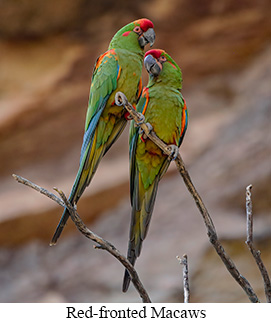
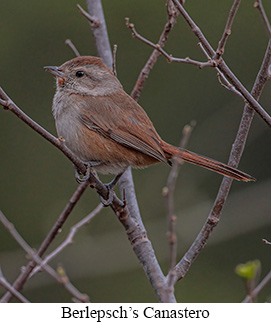 The tour begins at the city of Santa Cruz de la Sierra in central Bolivia at the edge of the Chaco. Our first day is devoted to birding Lomas de Arena south of the city and the botanical gardens within the city limits. From there the tour proceeds to Bermejo and on to Refugio Los Volcanes for much of two days birding the canyonlands there. A stop at Samaipata to seek out Tucuman Parrot and Dot-winged Woodpecker near Quirusillas follows. Then the tour proceeds to Pereralta, best place to find the critically endangered Red-fronted Macaw along with Cliff Parakeet. A full day transfer to Comarapa with birding en route is followed by a full day birding nearby Siberia Cloud Forest above the city to seek out the difficult Rufous-faced Antpitta as well as Diademed Tapaculo and others. The transfer to Cochabamba, a heavily agricultural area surrounded by great birding sites, follows. Three full days will be devoted to birding the upper and lower sections of Chapare Road, Cerro Tunari, and Laguna Alalay before we fly to La Paz. Next is a birding excursion to Coroico, birding the upper and lower sections of the famed Old Coroico Road. After spending the morning birding around Coroico, we transfer to the town of Sorata for a one night stay. We'll devote the next morning seeking out the very range restricted endemic Berlepsch's Canastero followed by transfer back to La Paz. We'll spend our last morning at Lake Titicaca to view the endemic flightless Titicaca Grebe. The tour ends at the airport that afternoon or evening.
Tour Considerations
PACE - The pace of this tour is fairly moderate.
DIFFICULTY - Most birding is along fairly flat dirt roads and trails, though a few trails are steeper. It should be noted that birding along the Old Coroico Road can be a little unnerving, as this road is cut out of steep mountainsides, is narrow, and lacks guard rails. It is considered to be one of the most dangerous roads in South America.
CLIMATE - Bolivia has two distinct seasons. Dry season is from May to October and wet season is from November to March. During dry season days are sunny and there is very little rainfall. During wet season, temperatures are warmer and heavery afternoon thunderstorms are frequent. Higher elevations around La Paz can be quite cold, dropping down to freezing at night during dry season. It should be noted that farmers typically burn off their fields during dry season, especially in September, when a pall of smoke typically lingers in the air over the central valleys of the interior. These burns sometimes escape into surrounding forests, causing massive out-of-control wildfires.
BIRD ACTIVITY- Birding is very good throughout the year but is affected by the climate. Peak breeding activity is from October to December. During dry season vegetation is less lush so birds are easier to see. In addition, birds congregate around water sources and fruiting trees during dry season, with mixed species flocks more in evidence. Dry season is a good time to see the endangered Red-fronted Macaw. Wet season is a good time to see the nesting behavior of that species.
PHOTOGRAPHY - Chances for bird photography during the tour are largely opportunistic except at the Red-fronted Macaw Lodge where there are some outdoor feeders.
TOUR NOTES
Internal flight not included in tour price. May be combined with our Apolo, Beni, and Chaco extensions or even our Eastern Bolivia tour.
ACCOMMODATIONS
Accommodations will be mainly in -level hotels and ecolodges. The Los Volcanes Lodge and Armonia Lodge are quite comfortable.