


CENTRAL BOLIVIA TOUR
Tour Description

BOLIVIA
BIRDING TOUR
ANY TIME*
| Duration: | 15 days, 14 nights |
| Group Size: | 2-4 |
| 2-3 Price: | $6580 |
| 4+ Price: | $6280 |
| Single Suppl: | $300 |
| Est #Species: | 400-450 |
| Pace: | Moderate |
| Difficulty: | Moderate |
| Best Time: | May-Nov |
| * This tour is available for any dates of your choosing provided guide services and accommodations are available. | |
DAY 1 - ARRIVE SANTA CRUZ DE LA SIERRA
Arrive Santa Cruz de La Sierra, founded by Spanish conquistadores in 1561 and now Bolivia's most populous city. Depending on time of arrival, we could do some birding in the grasslands around the terminal where we could find White-bellied Nothura, Red-winged Tinamou, White Woodpecker, Chotoy Spinetail, and Chopi Blackbird. Those arriving a day early can explore the colonial-style city center, which features a mix of colonial era red-tile buildings mixed in with modern and futuristic designer outlets and skyscrapers. The streets are a busy melange of horse-drawn carts mixed in with modern Land Cruisers and Mercedes cars. Overnight at a hotel in Santa Cruz.
DAY 2 - LOMAS DE ARENA & BOTANICAL GARDENS
Santa Cruz is located on the Pirai River in tropical lowlands situated near the confluence of Amazonian rainforests to the north and dry Chaco desert to the south, with the Santa Cruz Mountains just west of the city and open savannas just east of the city. We'll depart Santa Cruz very early for a visit to Lomas de Arena Regional Park, located south of the city in the northern-most extent of the Chaco. The park protects a desert region with massive 12m high sand dunes surrounded by savanna, dry forest, lagoons, and tropical forests. It's best to arrive around daybreak before strong winds potentially start picking up later in the day. Birding is primarily along the single road that goes through the park. The main target birds there are Red-winged Tinamou, heard whistling at dawn and hopefully seen in the savanna, Small-billed Tinamou, an unobtrusive species found in the brush, and Red-legged Seriema. Other specialties include Greater Rhea, Comb Duck, White-eared Puffbird, Spot-backed Puffbird, White-edged Piculet, White Woodpecker, Peach-fronted Parakeet, Chotoy Spinetail, Hudson's Black-Tyrant, and Chopi Blackbird.
After lunch we'll visit the Santa Cruz Botanical Gardens, a 200+ hectare nature reserve located about 12km east of the city. This reserve protects dry forest with numerous walking trails along with a cactarium and orchidarium.. The two main target species there are White-bellied Nothura, a skulker found in weedy areas that takes some diligence to find, and the near-endemic Bolivian Slaty Antshrike, a species usually easy to see. Other special birds we hope to see are Buff-bellied Hermit, Mato Grosso Antbird, and Red-Billed Scythebill. Additional forest and Chaco species include Greater Rhea, Chaco Chachalaca, Green-cheeked Parakeet, Chestnut-fronted Macaw, Great Antshrike, Black-capped Antwren, Band-tailed Manakin, Straneck's Tyrannulet, Fawn-breasted Wren, and Orange-headed Tanager. Overnight at a hotel in Santa Cruz.
DAY 3 - TRANSFER & REFUGIO LOS VOLCANES
After early breakfast, we'll transfer to Refugio Los Volcanes, about a 2 hour drive from Santa Cruz to Bermejo. This site is a privately owned nature preserve located in an isolated valley on the edge of Amboro National Park in the Santa Cruz Mountains. From the entrance we'll drive down a steep road to the lodge area, which is situated in a basin below sheer red sandstone cliffs that encircle the area. The habitat is semi-humid foothill forest. Near the base of the cliffs is an extensive semi-humid foothill forest that can be birded along an extensive network of trails.
Special birds of the area are the near-endemic Slaty Gnateater, a shy species of the understory, the typically skulky Bolivian Tapaculo, and the rare and oddly different Bolivian Recurvebill, whose presence depends on the condition of bamboo stands around the lodge. We can also hope to find the range-restricted and rather tricky-to-see Yungas Manakin along with secretive species such as Gray Tinamou, Brown Tinamou, Rufous-breasted Wood-Quail, and Gray-throated Leaftosser plus the scarce Blue-browed Tanager.
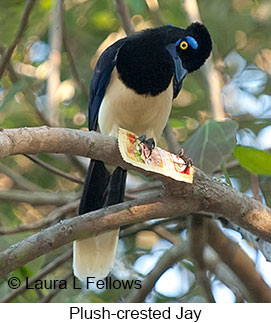
We should see a wide variety of more widely distributed birds while birding the forest. Possibilities include White-throated Piping-Guan, a recent split from Blue-throated Piping-Guan, Razor-billed Curasssow, Sunbittern, the spectacular Red-necked Woodpecker, Black-capped Antwren, Ocellated Woodcreeper, Tschudi's Woodcreeper, Inambari Woodcreeper, Buff-fronted Foliage-gleaner, Plush-crested Jay, Dusky-green Oropendola, Two-banded Warbler, Black-goggled Tanager, and many others. Along the entrance road we could find Chestnut-backed Antshrike, White-bellied Pygmy-Tyrant, and White-winged Tanager. During dry season Andean Condors regularly soar overhead. Large numbers of Mitred Parakeets and Turquoise-fronted Parrots are usually present along with less common Military Macaws. Night birding may produce Rufescent Screech-Owl and Band-bellied Owl. Overnight at Refugio Los Volcanes Lodge.
DAY 4 - REFUGIO LOS VOLCANES & TRANSFER TO SAMAIPATA
We'll spend much of this day birding around Refugio Los Volcanes. In mid-afternoon we'll transfer to Samaipata, a 2½ hour drive. Samaipata is a large town in the middle of a largely deforested plateau and offers scant birding that is readily accessible without a substantial hike. Overnight at a hotel in Samaipata.
DAY 5 - QUIRUSILLAS & PERERETA
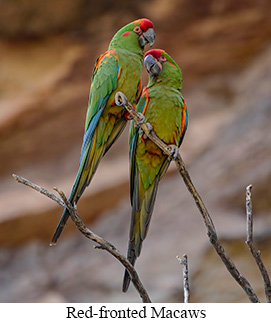
We'll depart very early and drive up the unpaved road to Quirusillas to bird a remnant tract of Tucumano-Boliviano montane forest. This forest is a unique subtropical habitat of the Yungas region of southern Bolivian and northwestern Argentina. We want to arrive there at dawn to give us our best chance of seeing Red-faced Guan, Tucuman Amazon, and Dot-fronted Woodpecker. From September to March it's possible to see the highly migratory Slaty Elaenia. Other possibilities include the rare Blue-capped Puffleg, Masked Trogon, Giant Antshrike, Short-tailed Antthrush, the near-endemic Buff-banded Tyrannulet, the shy Speckled Nightingale-Thrush and Andean Slaty-Thrush, the rather uncommon Golden-winged Cacique, and Green-throated Tanager. Sometimes Andean Condors are seen soaring overhead. A brief stop at the waterfall outside Samaipata is worth a visit for Sharp-tailed Streamcreeper. After spending the morning birding Quirusillas, we'll continue on to the Red-fronted Macaw Reserve, located near Perereta, about a 3-4 hour drive. Overnight at Armonia Red-fronted Macaw Ecolodge.
DAY 6 - RED-FRONTED MACAW RESERVE & TRANSFER TO COMARAPA
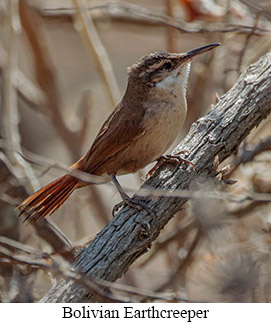
Our main target bird this morning is the critically endangered endemic Red-fronted Macaw. Only about 3000 individuals still remain. The macaws breed from November to May, and those are the best months to see them. Nevetheless, they are resident in the area and can be reliably seen on roosting cliffs during early morning. While in the reserve, we'll also seek out three more endemics, namely Cliff Parakeet, Bolivian Earthcreeper, and Bolivian Blackbird, along with the range-restricted Gray-hooded Parakeet.
Other possibilities we may see include White-bellied Hummingbird, Streak-fronted Thornbird, Spot-breasted Thornbird, Stripe-crowned Spinetail, Greater Wagtail-Tyrant, Ultramarine Grosbeak, Gray-crested Finch, Ringed Warbling Finch, Black-capped Warbling Finch, and Rufous-sided Warbling Finch. Feeders around the lodge attract White-fronted Woodpecker, White-tipped Plantcutter, and several tanager species.
After lunch we'll transfer to Comarapa, stopping along the way for some birding. Comarapa is a provincial town located in an inter-montane valley beneath the Siberia massif, not far from some of the best cloud forest birding in Bolivia. Overnight at a hotel in Comarapa.
DAY 7 - SIBERIA CLOUD FOREST & COMARAPA YUNGAS
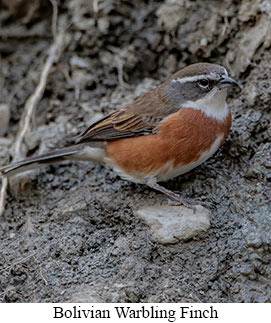
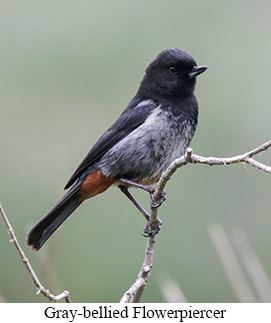
We'll depart before dawn for Siberia cloud forest and spend all day birding roadside trails of the area. An effort will be made to see the difficult Rufous-faced Antpitta. Other target species we hope to find include the near-endemic Diademed Tapaculo, Spot-breasted Thornbird and Light-crowned Spinetail, the endemic Black-throated Thistletail and Bolivian Brushfinch, and the always difficult Chestnut-crested Cotinga. The transition zone between cloud forest and the dry valley below is where warbling-finches are found. After descending down the mountain road to lower elevation, we should see Ringed Warbling-Finch, which is quite common, and we have good chances of also finding Rusty-browed Warbling Finch and Black-and-chestnut Warbling Finch. Much less common but possible is Bolivian Warbling-Finch. Also present at this lower elevation are Red-tailed Comet, Freckle-breasted Thornbird, Yellow-billed Tit-Tyrant, and Gray-bellied Flowerpiercer.
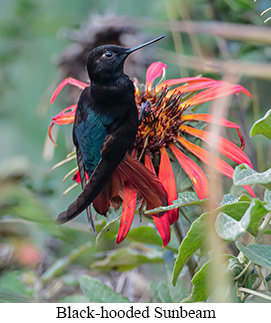
Numerous other birds are possible this very birdy day including Black-hooded Sunbeam, Ocellated Piculet, Olive-crowned Crescentchest, Buff-banded Tyrannulet, Rufous-breasted Chat-Tyrant, Rust-and-yellow Tanager, Blue-capped Tanager, and Chestnut-bellied Mountain Tanager. Overnight at a hotel in Comarapa.
DAY 8 - TRANSFER TO COCHABAMBA
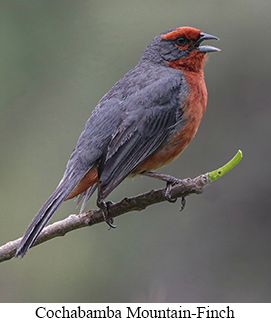
We'll depart very early for the transfer to Cochabamba with several birding stops en route. The drive time is about 5 hours, but we'll be stopping at several sites for birding en route, so it will be quite a long day. After crossing the Siberia watershed, we'll reach some dry valleys occupied by Quechua speaking people. We'll do some birding in small gullies filled with Polylepis trees of high elevation elfin forest to seek out endemics such as Black-hooded Sunbeam, Bolivian Antpitta, and Cochabamba Mountain-Finch along with near-endemic Wedge-tailed Hillstar, Maquis Canastero, Rufous-bellied Mountain Tanager, and Citron-headed Yellow-Finch along with the near-endemic Rusty-browed Warbling Finch.
Aside from endemics, we should see a variety of more widely distributed species during our birding stops. Among the possibilities are Giant Hummingbird, Slender-billed Miner, Brown-capped Tit-Spinetail, Tufted Tit-Tyrant, White-winged Black-Tyrant, Rufous-webbed Bush-Tyrant, Blue-and-yellow Tanager, and Greenish Yellow-Finch. During dry season from May to October, the rare austral migrant Tawny-throated Dotterel may also be encountered. Overnight at a hotel in Cochabamba
DAY 9 - UPPER CHAPARE ROAD
The Chapare Road leads into the highlands northeast of Cochabamba toward the town of Chapare. The upper section goes up and over the east slope of the Andes and is home to some good birds. Much of the forest has been cut but some patches remain. We'll be especially looking for Hooded Mountain-Toucan (quite rare), Yellow-rumped Antwren, (quite uncommon), Puna Tapaculo, a typical tapaculo skulker, Brown-capped Tit-Spinetail, Rusty-vented Canastero, Maquis Canastero, Orange-browed Hemispingus, Bolivian Warbling Finch, all near-endemics. Difficult to see but possible there are Huayco Tinamou and Stripe-faced Wood-Quail. Other possibilities along the upper road include Barred Antthrush, Chestnut-crested Cotinga, White-eared Solitaire, Hooded Mountain Tanager, Grass-green Tanager, and Scarlet-bellied Mountain Tanager.
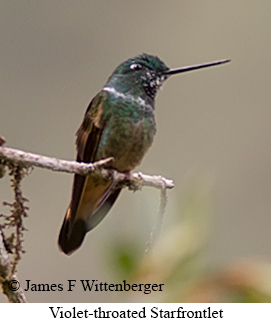
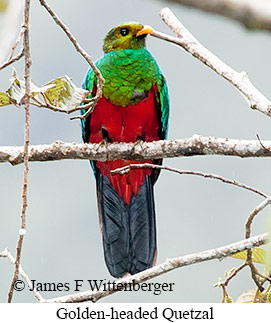
A side road leading to Tablas Monte goes through disturbed forest and cleared fields. A number of interesting species are possible there including Violet-throated Starfrontlet, Golden-headed Quetzal, Black-winged Parrot, the endemic Black-throated Thistletail, Band-tailed Fruiteater, and Chestnut-bellied Mountain Tanager. Overnight hotel in Cochabamba.
DAY 10 - LOWER CHAPARE ROAD
This day will be devoted to birding the lower section of the Chapare Road between 800 and 1800m elevation. Some pristine forest still remains although much of the forest has been cut. Most birding is along this unpaved road. Unfortunately, there is usually heavy traffic as this is the main road between Cochabamba and Santa Cruz. The slopes are steep and have few trails up them, so we must tolerate the traffic. Target species are the near-endemic Blue-banded Toucanet, Upland Antshrike, Yellow-rumped Antwren, and the skulky Yungas Tody-Tyrant. A side road leads through a forest filled with bamboo patches and is often good for the rare Green-throated Tanager. Overnight at a hotel in Cochabamba.
DAY 11 - CERRO TUNARI
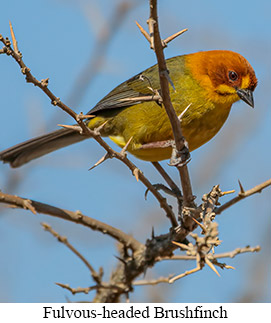
This morning we'll drive up the Quillacolla Road into the highlands. The rough track ascends steeply with frequent hairpin turns up the slopes of Cerro Tunari, Bolivia's tallest mountain east of the altiplano, topping out at 5035m (16,519ft). This road is considered by many one of the best birding sites in South America. The road goes through an agricultural area before rising steeply through scrub and Polylepis woodland to eventually reach Puna grassland. The scrub habitat along the lower section is good for the scarce near-endemic Bolivian Warbling Finch and the highly localized endemic Cochabamba Mountain-Finch along with Bolivian Blackbird and Gray-bellied Flowerpiercer. Higher up is the scarce and very localized Wedge-tailed Hillstar as well as Maquis Canastero. The Polylepsis forest around 3500m is home to Tawny Tit-Spinetail and one of the few places where Rufous-bellied Mountain Tanager is possible. The latter species and Cochabamba Mountain-Finch are also possible in the first few kilometers of the nearby Liriuni Road if missed here. The highest elevations of Puna grassland above 4000m is sometimes good for Short-tailed Finch and several ground-tyrants. Other possibilities this day include Red-tailed Comet, Green-barred Woodpecker, Andean Parakeet, Rock Earthcreeper, Bolivian Earthcreeper, Brown-capped Tit-Spinetail, Scribble-tailed Canastero, Puna Canastero, Spot-billed Ground-Tyrant, Cinnamon-bellied Ground-Tyrant, Fulvous-headed Brushfinch, Black-hooded Sierra Finch, Ringed Warbling Finch.
That afternoon we'll visit Laguna Alalay within the city limits of Cochabamba. The lake is very good for waterfowl. The most interesting of these are Andean Duck and White-tufted Grebe. Reeds along the shoreline are good for Wren-like Rushbird, Many-colored Rush Tyrant, and Yellow-winged Blackbird. From there we'll transfer to the airport in time for our early evening flight to La Paz. Overnight hotel in La Paz.
DAY 12 - COROICO ROAD
We'll depart very early for the town of Coroico, taking the new highway out of La Paz. The famed Coroico Road is often considered the most spectacular highway in South America. In just 100km (63 miles) it first rises to an elevation of 4650m (15,260ft) at La Cumbre and then descends rather steeply to just 1200m (3940ft) at the town of Coroico, passing from puna through cloud forest, middle elevation Yungas forest, and subtropical forest along the way.
Birding begins at higher elevation along the new road where Rufous-bellied Seedsnipe and Gray-breasted Seedsnipe are likely to be found foraging in the puna grassland and bogs at the pass. A site 4km before the pass at La Cumbre is a good place for White-winged Diuca-Finch. Also present in the cloud forest around La Cumbre are Black-and-chestnut Eagle, Blue-mantled Thornbill, Hooded Mountain-Toucans, White-collared Jay, Plumbeous Sierra-Finch, and the difficult to see Short-tailed Finch. The Pongo area around 3800m elevation is a good site for the near-endemic Diademed Tapaculo and the range-restricted Scribble-tailed Canastero.
Some of the best birding is along the Old Coroico Road, which begins about two thirds of the way to the town of Coroico. The old road is known as the "Death Road", aptly named as it is a narrow dirt road carved out of very steep hillsides. In the middle elevation Yungas forest along this road we'll look for the scarce and secretive range-restricted near-endemic Scimitar-winged Piha. Other possibilities include the range-restricted Rufous-capped Antshrike and the near-endemic Upland Antshrike, Band-tailed Fruiteater, and Bolivian Tyrannulet. We'll see many other more widely distributed species as well. Overnight at a hotel in Coroico.
DAY 13 - COROICO AREA & SORATA
We'll devote the morning to seeking out lower elevation birds around Coroico. Notables include Brown Tinamou, Light-crowned Spinetail, Rufous-bellied Bush-Tyrant, and Orange-browed Hemispingus.
After lunch we'll drive back up toward La Paz, this time only on the new road, and continue on to the small, scenic village of Sorata where we'll spend the night. The transfer takes about 5 hours so we'll want an early lunch before departing. Overnight at a hotel in Sorata.
DAY 14 - SORATA AREA & LA PAZ
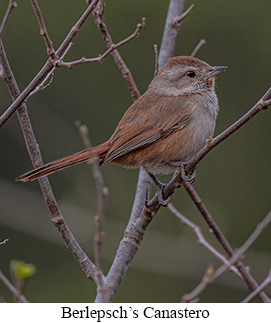
We'll depart our hotel very early for the upper Sorata Valley. This dry valley is home to our main target species near Sorata, Berlepsch's Canastero, which occurs in remnant scrub habitat in this dry valley. It builds huge stick nests in taller Eucalyptus trees, so it is readily observed. Also present there are Spot-winged Pigeon, Green-tailed Trainbearer, Black-hooded Sunbeam, Mitred Parakeet, Streak-throated Bush-Tyrant, Yellow-bellied Siskin, and Cinereous Conebill. When we drive back toward town, a few ponds will likely yield Chilean Flamingo, Giant Coot, and Puna Ibis. Mid-afternoon transfer back to La Paz, about a 3½-hour drive. Overnight at a hotel in La Paz.
DAY 15 - LAKE TITICACA & FLIGHT HOME
Morning visit Lake Titicaca. The primary target bird is the Titicaca Grebe, which can typically be seen swimming around reedbeds along the shoreline. Other likely birds include Andean Goose, Crested Duck, Plumbeous Rail, Puna Miner, Many-colored Rush Tyrant, Short-billed Pipit, Yellow-winged Blackbird, Band-tailed Sierra Finch, and Grassland Yellow-Finch. Mid-day we'll transfer to the airport for our international flights home. Tour ends at the airport.
TOUR NOTES
Internal flight not included in tour price. May be combined with our Apolo, Beni, and Chaco extensions or even our Eastern Bolivia tour.
ACCOMMODATIONS
Accommodations will be mainly in -level hotels and ecolodges. The Los Volcanes Lodge and Armonia Lodge are quite comfortable.
BIRDING LOCALES
FOR THIS TOUR