


CENTRAL PERU BIRDING TOUR
Tour Description

PERU
BIRDING TOUR
ANY TIME*
| Duration: | 18 days, 17 nights |
| Group Size: | 2-4 |
| 2-3 Price: | $7850 |
| 4+ Price: | $7550 |
| Single Suppl: | $600 |
| Est #Species: | 375-425 |
| Pace: | Moderate |
| Difficulty: | Moderate |
| Best Time: | May-October |
| * This tour is available for any dates of your choosing provided guide services and accommodations are available. | |
DAY 1 - LIMA
Arrive at international airport in Lima and transfer to your hotel near the airport. Overnight at LimaQ Hotel.
DAY 2 - LOMAS DE LACHAY & PARAISO LAGOON
After breakfast, we'll transfer to Lomas de Lachay, an arid hilly area near the coast north of Lima. The habitat is very dry in dry season but surprisingly green during rainy season. The entrance road passes through a flat, arid plain where the main birds of interest are a small desert race of Burrowing Owl, Least Seedsnipe, Coastal Miner, and Grayish Miner. The hills and desolate canyon within the reserve are home to Purple-collared Woodstar, Oasis Hummingbird, Amazilia Hummingbird, Thick-billed Miner, Cactus Canastero, Peruvian Pipit, Peruvian Meadowlark, Band-tailed Sierra Finch, and Grassland Yellow-Finch. Also possible but less likely is the nomadic Raimondi's Yellow-Finch.
After lunch we'll visit the coastal lagoon around Paraiso and a sandy beach at Albufera where we should find White-tufted Grebe, Great Grebe, West Peruvian Dove, Peruvian Thick-knee, Gray-hooded Gull, Gray Gull, Kelp Gull, Many-colored Rush Tyrant, Peruvian Martin, Long-tailed Mockingbird, and Yellowish Pipit. Various marine species may be seen flying by along the coast, including Inca Tern, Guanay Cormorant, Peruvian Pelican, and perhaps others. Overnight at a hotel in Barranca.
DAY 3 - TRANSFER & LAKE CONOCOCHA
We'll depart early for Lake Conococha, a 3-hour drive into the highlands. We'll be driving up a long winding road through arid canyons of the western Andes. At a dry canyon en route we'll stop to look for Great Inca Finch. We may also find Peruvian Pygmy-Owl, Pacific Parrotlet, Scarlet-fronted Parakeet, Russet-bellied Spinetail, Fulvous-faced Scrub-Tyrant, Baird's Flycatcher, and Pale-footed Swallow.
We'll continue driving upslope to the high elevation Lake Conococha, located at an elevation of 4050m (13,287ft). Birding there should be quite productive, with likely birds typically present being Puna Teal, Yellow-billed Pintail, White-cheeked Pintail, Yellow-billed Teal, Chilean Flamingo, Silvery Grebe, Giant Coot, Andean Gull, Puna Ibis, White-winged Cinclodes, and Andean Negrito. Across the road, a dirt trail skirting the wetlands is good habitat for several other species including Cream-winged Cinclodes, Streak-backed Canastero, Corilleran Canastero, and Ochre-naped Ground-Tyrant. a After stopping for lunch in the town of Conococha, we'll continue north to the town Yungay, about another 3 hours drive. Overnight at a hotel in Yungay.
DAY 4 - HUASCARAN NATIONAL PARK
We'll devote all day birding along the road into Huascaran National Park. The Park doesn't open until 8:00am, and we plan to reach the park entrance around that time. The road up passes through a couple altitudinal zones before reaching Lago Llanganuco, which lies at an elevation of 3850m (12,630ft).
We'll make many stops for birding, including at the Quebrada Llanganuco. Along this trail through taller Polylepis woodland we can expect to see the near-endemic Jelski's Chat-Tyrant, the endemic Plain-tailed Warbling Finch, and the more widely distributed nomadic Giant Conebill.
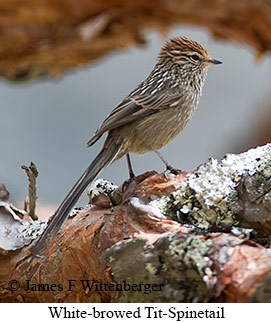
As the road ascends gradually upwards, we'll enjoy the dramatic scenery of stark canyon walls surrounding the valley while birding alpine scrub habitat along the road. Endemics and near-endemics we can expect to find in this habitat include Green-headed Hillstar and Black Metaltail flitting among flowering scrubland plants, along with furtive denizens of dense shrubbery such asStriated Earthcreeper, Rusty-crowned Tit-Spinetail, Creamy-crested Spinetail, Line-cheeked Spinetail, Rufous-eared Brushfinch andPlain-tailed Warbling Finch. We'll we'll spend some time tryig to see the secretive Stripe-headed Antpitta and Ancash Tapaculo lurking in the dense alpine scrub. We'll keep an eye out for Jelski's Chat-Tyrant, an unobtrusive species that is often overlooked. More readily seen are the endemic Peruvian Sierra Finch and near-endemic Tit-like Dacnis.
A mega target bird in this area is the scare and local White-cheeked Cotinga, which is normally found foraging on mistletoe berries in Polylepis forest and is rarely seen around the lagoon. The best habitat is on the other side of a high mountain pass that tops out at 4900m (16,100ft). It's a rather rough road that is best driven with a high clearance vehicle but with care can be navigated with a regular van. The good habitat takes a couple hours each way to reach, but the extra effort is worthwhile. Not only do we have a good chance of seeing the cotinga, but also the birding around that area is truly superb. Other good birds there include Line-cheeked Spinetail, Rufous-webbed Bush-Tyrant, Plain-tailed Warbling Finch, and Rufous-eared Brushfinch. Overnight at a hotel in Yungay.
DAY 5 - HUANUCO
We'll depart after early breakfast for a long drive from Yungay to Huanuco. This drive ordinarily takes around 8 hours but extensive construction en route is currently adding another couple hours to the transfer. We'll pass through the Cordillera Blanca and into the Cordillera Huayhuash beyond Huaraz, where the scenery becomes quite dramatic, featuring high white-capped mountains of the central Andes. Birding sites en route are limited, and with current construction delays, we probably won't have time for any birding stops. Overnight at a hotel in Huanuco.
DAY 6 - BOSQUE UNCHOG
We'll depart very early for a sometimes steep drive up a winding, dirt road into the higher elevation paramo above the town of Acomayo beyond the town of Churubamba. We'll want to arrive shortly after daybreak, so we'll carry a box breakfast with us. It will likely be very cold when we arrive, but it soon warms up enough for us to start shedding layers of clothing. At the end of the road at an elevation of about 3600m (11,800ft), we'll begin walking a trail through alpine grassland, paramo, and eventually stunted forest. The trail leads up and down before dropping steeply down to the valley below. At this altitude the hiking is a bit tiring but well worth the effort.
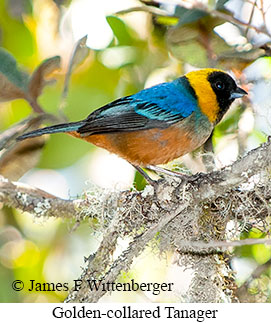
Some 50 years ago a research expedition discovered several new bird species in this area, namely Bay-vented Cotinga, a very strange small tanager named the Pardusco, and the brilliantly colored Golden-backed Mountain Tanager. These birds are by no means certainties to be seen. The best habitat for the cotinga and mountain-tanager is the elfin forest found quite far along the trail just before it drops off to much lower elevation. It may be necessary to hike down the steep part of the trail a ways to find these two species. At the third forest patch along the trail, both Chachapoyas Antpitta and Rufous-browed Hemispingus are possible. These are the toughest of the several difficult birds to see. Many other specials are likely to be seen, including Purple-backed Thornbill, Blue-mantled Thornbill, Coppery Metaltail, possibly Undulated Antpitta, Puna Tapaculo, Neblina Tapaculo, White-browed Spinetail, Red-rumped Bush-Tyrant, Rufous-breasted Chat-Tyrant, Brown-backed Chat-Tyrant, and Golden-collared Tanager. Overnight at a hotel in Huanuco.
DAY 7 - BOSQUE UNCHOG OR BOSQUE MONTEPOTRERO
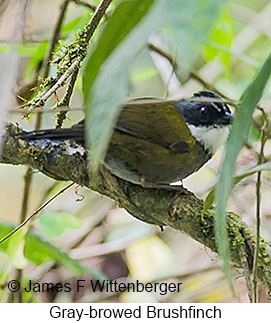
The plan this day is to visit a fairly new reserve near Huanuco called Bosque Montepotrero. This community-run forest reserve is one of the more accessible sites for finding the Panao Antpitta, which was recently split from Rufous Antpitta. The bird is quite common in the reserve but rather difficult to actually see. Hiking in the reserve is easy along relatively flat trails along hillsides, with the habitat consisting of a mix of pastures and forest edge. There are other birds of interest present as well, including the equally difficult to see Curve-billed Tinamou along with Black-tailed Trainbearer, Green-tailed Trainbearer, Coppery Metaltail, Black Metaltail, three other species of antpittas and four species of tapaculos that are also difficult to see, Gray-browed Brushfinch, Orange-headed Tanager, Rufous-chested Tanager, the endemic Brown-flanked Tanager, Chestnut-bellied Mountain Tanager, Plushcap, Rufous-browed Hemispingus, and Golden-billed Saltator.
If the key target birds were missed the previous day, we have the option of going back up to Bosque Unchog to look for them again. Overnight at a hotel in Huanuco.
DAY 8 - CARPISH TUNNEL TRAIL & JUNIN
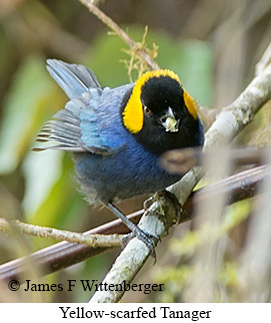
We'll depart early for the Carpish Tunnel area north of Huanuco. The road winds up through the mountains, and in the absence of trucks it would take maybe 40 minutes to reach the tunnel. However, trucks moving at 5-10 mph seem ever present, so it more typically takes an hour and a half to reach the Carpish area. We'll devote the morning to birding the Carpish Tunnel trail, which gradually rises along a steep hillside separating forest above from agricultural lands below. A number of antpittas and tapaculos are possible but difficult to see due to thick understory in the forest. Of these we hope to see Bay Antpitta and Chestnut Antpitta as well as Tshudi's Tapaculo. A good variety of other birds are also present including Rufous-capped Thornbill, Violet-throated Starfrontlet, Golden-headed Quetzal, Gray-breasted Mountain-Toucan, Streak-headed Antbird, Rufous Spinetail, Barred Fruiteater, Barred Becard, White-tailed Tyrannulet, White-banded Tyrannulet, the endemic Unstreaked Tit-Tyrant, Tawny-rumped Tyrannulet, Rufous-webbed Bush-Tyrant, Peruvian Wren, Bay-crowned Brushfinch, Pale-legged Warbler, White-capped Tanager, Rufous-crested Tanager, Black-capped Hemispingus, the very different "White-bellied" subspecies of Superciliaried Hemispingus, the endemic Brown-flanked Tanager, Pardusco, and Yellow-scarfed Tanager, the more widely distributed Plushcap, Drab Hemispingus, Gray-hooded Bush Tanager, and Black-and-white Seedeater. After returning to Huanuco for lunch, we'll depart for Junin, about a 4 hour drive. En route we'll stop at a site near Huariaca to look for Rufous-backed Inca Finch. Overnight at a hotel in Junin.
DAY 9 - JUNIN AREA
During the morning we'll be birding around the lake and marsh outside Junin. We'll join with a local guide who knows where all the specialties can be seen. First stop is a marsh area where we should be able to lure out a Junin Rail with playback for brief views. This bird is currently considered a subspecies of Black Rail, an always very difficult species to see.
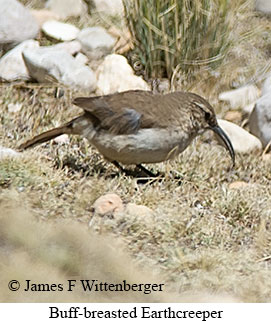
Then we'll go to a boat launch for a boat ride toward the center of the lake, which is the only way to see Junin Grebes. The population is decreasing but we should be able to see them. After the boat trip, we'll visit several sites to find Golden-spotted Ground Dove, Black-breasted Hillstar, Puna Snipe, Common Miner, Dark-winged Miner, Buff-breasted Earthcreeper, Olive-backed Foliage-gleaner, Junin Canastero, Cordilleran Canastero, and Bright-rumped Yellowfinch with the help of our local guide. We should see Ornate Tinamous along the road, as they are fairly common. We may also be able to see Barn Owl and Lesser Horned Owl, if our local guide still knows of their roosting sites. After lunch in Junin, we'll transfer to Villa Rica in the Oxapampa Province, about a 4-hour drive. Overnight at a hotel in Villa Rica.
DAY 10 - BOSQUE SHOLLET & ULCUMANO ECOLODGE
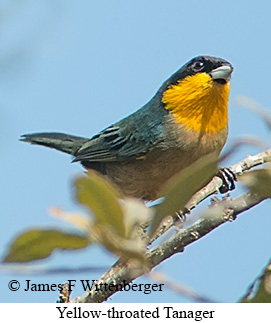
Bosque Shollet is a cloud forest site located between the towns of Villa Rica and Oxapampa. Birding is along the road, which has recently been regraded so now has heavier traffic than previously. This cloud forest site offers good birding with several key species present. We'll spend the morning birding this area. Birding is a bit of a challenge in the dense understory. Of special interest we hope to see are the range-restricted Black-winged Parrot, Trilling Tapaculo, Long-tailed Tapaculo, Rufous-vented Tapaculo, Buff-browed Foliage-gleaner, possibly even Chestnut-crested Cotinga, Inca Flycatcher, and Rufous-bellied Bush-Tyrant. Also possible are Bar-bellied Woodpecker, Black Antbird, Chestnut-winged Foliage-gleaner, White-eared Solitaire, Tricolored Brushfinch, Yellow-throated Tanager, Silvery Tanager, Blue-and-black Tanager, and Bluish Flowerpiercer. That afternoon we'll transfer to Ulcumano Ecolodge in the highlands above the town of Oxapampa. After arrival, we'll visit the canopy tower where Chestnut-crested Cotinga can usually be seen. Overnight at Ulcumano Ecolodge.
DAY 11 - ULCUMANO ECOLODGE
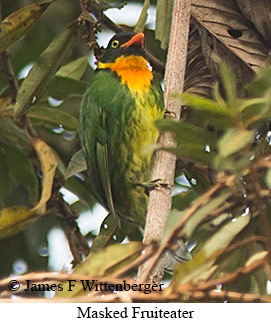
Ulcumano Ecolodge is surrounded by some good forest. We'll be birding mainly along the access road and a dirt road that leads off the main highway to it. Numerous species are possible including Speckled Hummingbird, Emerald-bellied Puffleg, White-bellied Woodstar, White-bellied Hummingbird, Black Hawk-Eagle, Bay Antpitta, Rufous-vented Tapaculo, Buff-browed Foliage-gleaner, Masked Fruiteater, Fulvous-breasted Flatbill, Yellow-crowned Tyrannulet, Black-capped Tyrannulet, Peruvian Tyrannulet, Rufous-tailed Tyrant, White-eared Solitaire, Tricolored Brushfinch, Fawn-breasted Tanager, Blue-and-black Tanager, Flame-faced Tanager, Bluish Flowerpiercer, and Gray-hooded Bush Tanager. At dusk Swallow-tailed Overnightjars can often be found along the road. Owling in the evening may produce Cloud-forest Screech-Owl and Rufous-banded Owl. Overnight at Ulcumano Ecolodge.
DAY 12 - ULCUMANO ECOLODGE & TRANSFER
We'll spend the morning birding around the lodge grounds looking for any species we missed the previous day. After lunch, we'll drive about 3 hurs to the town of Satipo, our next destination. Overnight at a hotel in Satipo.
DAY 13 - SATIPO ROAD
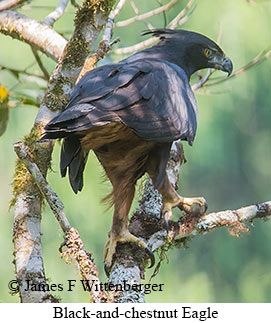
We'll depart early for the drive up the Satipo Road toward the village of Calabaza. Much of this section of the road is agricultural but a good variety of birds are possible, including Chestnut-collared Swift, Black-and-chestnut Hawk-Eagle (rare), Lemon-throated Barbet, Chestnut-eared Aracari, Lafresnaye's Piculet, Yellow-tufted Woodpecker, Crimson-crested Woodpecker, White-eyed Parakeet, Black-tailed Tityra, Black-crowned Tityra, Black-capped Becard, White-collared Jay, Violaceous Jay, Olivaceous Siskin, Magpie Tanager, the white-bellied subspecies of Superciliaried Hemispingus, Yellow-bellied Tanager, and Dull-colored Grassquit.
After lunch at a restaurant in Calabaza, we'll bird the upper section of Satipo Road. Many additional species are possible including Wire-crested Thorntail, Sword-billed Hummingbird, Sapphire-spangled Emerald, Andean Motmot, Montane Woodcreeper, Mountain Wren, Common Chlorospingus, Gray-browed Brushfinch, Slaty Brushfinch, Pale-legged Warbler, Capped Conebill, and Cinereous Conebill. In the evening we'll look for Lyre-tailed Overnightjar outside town. Overnight at a very basic community center outside Calabaza.
DAY 14 - ANDAMARCA VALLEY
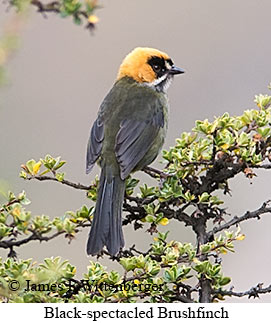
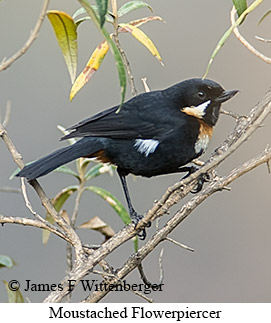
We'll spend all day birding an altitudinal transect into the Andamarca Valley and down toward the Mantaro Valley. The first stop is at quite high altitude paramo where the main target species is the Jalka Tapaculo. We'll then work our way downslope where we expect to find Creamy-crested Spinetail, Rufous-breasted Chat-Tyrant, Black-spectacled Brushfinch, Moustached Flowerpiercer, and Golden-billed Saltator. Still lower we'll be targeting two undescribed birds that are likely new species, Mantaro Spinetail and Mantaro Wren.
We'll continue down the canyon all the way to the town of Andamarca and beyond into the Mantaro Valley where a third undescribed form, the Mantaro Thornbird is found. The poorly known endemic Koepcke's Screech-Owl has previously roosted in this area. If it's still present, we'll make an effort to see it.
Many other birds are possible this day as well, including Mountain Velvetbreast, Rufous-vented Whitetip, Stripe-headed Antpitta, Cream-winged Cinclodes, Cactus Canastero, Red-crested Cotinga, Highland Elaenia, Hooded Siskin, Yellow-breasted Brushfinch, Black-backed Grosbeak, Rufous-chested Tanager, Black-goggled Tanager, Buff-bellied Tanager, Grass-green Tanager, Chestnut-bellied Mountain Tanager, Black-throated Flowerpiercer, and Plain-colored Seedeater. Overnight at the community center outside Calabaza.
DAY 15 - UPPER SATIPO ROAD & FONDO ARMORIQUE
Early this morning we'll drive up the Satipo Road to the Carrizales Bridge. The main target birds at this higher elevation site are Fire-throated Metaltail, Junin Antpitta, Junin Tapaculo, and Eye-ringed Thistletail. We'll then work our way back down toward Calabaza. A good variety widely distributed species are possible along this transesct. After lunch, we'll transfer to Hacienda Armorique in the highlands above the town of La Merced. After arrival, we may have some time to bird the road just up from the lodge. At this lower elevation, birds such as Rufous-capped Nunlet, Bluish-fronted Jacamar, Lafresnaye's Piculet, Yellow-breasted Warbling-Antbird, Cabanis's Spinetail, White-bellied Pygmy-Tyrant, Yellow-crested Tanager, and Black-faced Dacnis are possible. This site is often good for finding owls, so we'll drive up the rough road after dinner to seek them out. Most likely are Rufescent Screech-Owl, the poorly known Cloud-forest Screech-Owl, and Rufous-banded Owl. Overnight at Hacienda Armorique.
DAY 16 - HACIENDA ARMORIQUE & TRANSFER
We'll ride in the back of the owner's 4-wheel-drive truck upwards along a quite rough road to higher elevation. There is good temperate forest all along this road. The main target species there the endemic Creamy-bellied Antwren and Cerulean-capped Manakin. Other birds we may see include Little Tinamou, Ocellated Piculet, Chestnut-backed Antshrike, Blackish Antbird, White-crowned Manakin, Streak-necked Flycatcher, Three-striped Warbler, Fawn-breasted Tanager, Spotted Tanager, Blue-necked Tanager, and Peruvian Sierra Finch. After lunch we'll transfer to the San Marcos area for an overnight stay. Overnight at a hotel near San Marcos.
DAY 17 - MARCAPOMACOCHA, MILLOQ BOG, & SANTA EULALIA
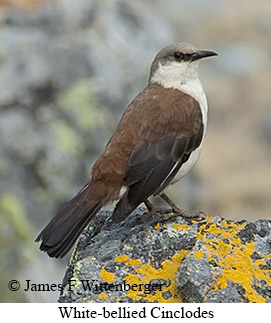
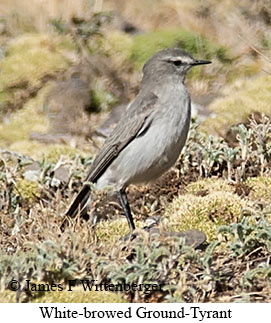
We'll depart early for the highlands around Marcapomacocha, stopping at a restaurant for breakfast en route. First stop is a pullout along the main road to look for the endemic and range-restricted White-bellied Cinclodes. Then we'll continue into the highlands, making several stops along the way including the Milloq bog area where we hope to find the rare Diademed Sandpiper-Plover. This species is most likely seen during breeding season from October to March but is possible at other times of year as well. Other birds of interest include Green-headed Hillstar, Rufous-bellied Seedsnipe, Gray-breasted Seedsnipe, Buff-breasted Earthcreeper, Streak-backed Canastero, Spot-billed Ground-Tyrant, Puna Ground-Tyrant, Dark-faced Ground-Tyrant, White-browed Ground-Tyrant, Glacier Finch, Ash-breasted Sierra Finch, Slaty Finch, Mourning Sierra Finch, Rufous-breasted Warbling Finch, and Bright-rumped Yellow-Finch. We'll drive up over the pass and down the other side into the Santa Eulalia Valley where an altitudinal transect down this very scenic valley may yield Torrent Duck, Giant Hummingbird, Rusty-crowned Tit-Spinetail, Thick-billed Siskin, Rusty-bellied Brushfinch, Drab Hemispingus, Greenish Yellow-Finch, and possibly some raptors. From there we return to Lima. Overnight at LimaQ Hotel
DAY 18 - END OF TOUR
End of tour in the morning. Transfer to airport for flight home.
ACCOMMODATIONS
Accommodations in the cities are at moderately priced hotels. Some of these require climbing up one or more flights of stairs. Accommodations at Calabaza above Satipo are in a very basic community center that has rooms separated by wafer board partitions, has no doors in the doorways, and has only a single, shared bathroom. Two nights will be spent in a working hacienda that offers private rooms for birders. The rooms are comfortable there and the meals are quite good, but everyone must share a single bathroom, which does have hot water in the shower.
BIRDING LOCALES
FOR THIS TOUR