


NAMIBIA BIRDING & WILDLIFE TOUR
Tour Description

NAMIBIA
BIRDING TOUR
ANY TIME*
| Duration: | 13 days, 12 nights |
| Group Size: | 2-4 |
| 2-3 Persons Price: | $6400 |
| 4+ Persons Price: | $6150 |
| Single Suppl: | $550 |
| Est #Species: | 275-325 |
| Pace: | Easy |
| Difficulty: | Easy |
| * This tour is available for any dates of your choosing provided guide services and accommodations are available. | |
DAY 1 - WINDHOEK
Flights typically arrive in Windhoek by mid day. If your flight arrives in the evening, it would be a good idea to arrive the night before the tour begins (hotel that night not included in price). Our guide will meet you at the aiport and start the birding from there. The arrivals area is the best place to see Orange River Francolin and South African Swallow. Other birds there include Little Swift, White-rumped Swift, Cape Wagtail, Southern Red Bishop, Black-faced Waxbill, Red-headed Finch, and Shaft-tailed Whydah.
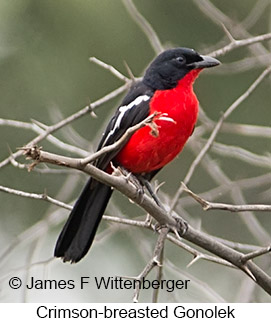
After checking in to the hotel, we'll go birding. Assuming time permits, we'll spend our first afternoon visiting the nearby Daan Viljoen Game Reserve, a small private reserve located just 24km from Windhoek. Driving the loop road through this reserve will give us our first views of Namibian mammals, including Mountain Zebra, Southern Giraffe, Hartebeest, Blue Wildebeest, Springbok, and Gemsbok. We'll also see a good variety of birds. Likely species include Red-billed Francolin, Golden-tailed Woodpecker, Sabota Lark, Rufous-vented Warbler, Groundscraper Thrush, Mariqua Sunbird, and Lark-like Bunting. Birding along and in the normally dry creek bed behind the lodge may turn up Spotted Eagle-Owl, Pearl-spotted Owlet, Crimson-breasted Gonolek, Golden-breasted Bunting, and Pin-tailed Whydah. If you arrive too late for this excursion, we'll bird some sites around Windhoek instead as time permits. Overnight at Arebbusch Travel Lodge in Windhoek.
DAY 2 - WINDHOEK & NAMIBGRENS
We'll begin our first full day in Namibia birding some sites around Windhoek. First stop will be the area around the sewage ponds where we can expect to see South African Shelduck, Hottentot Teal, Allen's Gallinule, Red-knobbed Coot, Three-banded Plover, White-throated Swallow, Great Reed Warbler, Rattling Cisticola, Zitting Cisticola, and Eastern Paradise-Whydah. We'll then bird the area around Avis Dam. This site offers a second chance to see Orange River Francolin if missed the preceding day. Many other birds are present in the nature reserve there as well. Notable species include Monteiro's Hornbill, Pied Barbet, Rosy-faced Lovebird, Rockrunner, Kalahari Scrub-Robin, and Short-toed Rock-Thrush. Several species of ducks and grebes are usually present along with African Fish-Eagle.
Mid morning we'll depart for Namibgrens, situated on the central plateau known as Khomas Hochland above Spreetshoogte Pass. The drive will take about 2½ hours across the arid central plateau and into the highlands of the coastal mountains. Once there we'll start our birding around the lodge, where we should find Karoo Scrub-Robin, Violet-backed Starling, Pale-winged Starling, and Dusky Sunbird.
That afternoon we'll bird our way part way down the incredibly scenic Spreetshoogte Pass. The main target bird in the pass is Herero Chat, always difficult and best found when it responds to playback. The pass is one of the best areas to find this quite scarce near-endemic. Other interesting possibilities include Pied Barbet, Cardinal Woodpecker, Bokmakierie, Chat Flycatcher, Short-toed Rock-Thrush, and Cape Wagtail. After dinner, we'll drive the dirt road near the lodge looking for nightjars along with nocturnal animals such as Common Genet. Overnight at Namibgrens Guesthouse.
DAY 3 - NAMIBGRENS, SPREETSHOOGTE PASS, & WELTEVREDE
At first light we'll drive a loop road through this arid gravel plains of the mountain plateau seeking birds of the arid scrub such as Red-billed Francolin, Golden-tailed Woodpecker, Sabota Lark, Rufous-vented Warbler, Groundscraper Thrush, Mariqua Sunbird, and Lark-like Bunting. Other birds we may see include Speckled Pigeon, Pied Barbet, possibly the erratically occurring Lesser Honeyguide, Cardinal Woodpecker, Sabota Lark, Cinnamon-breasted Warbler, Layard's Warbler, Kalahari Scrub-Robin, Short-toed Rock-Thrush, Tractrac Chat, Scaly Weaver, Cape Sparrow, and more. We can also expect to see some mammals in this area, including perhaps Bontebok, a strikingly beautiful antelope introduced from South Africa, along with Mountain Zebra, Southern Giraffe, Hartebeest, Blue Wildebeest, Red Hartebeest, Springbok, Gemsbok, Steenbok, Greater Kudu and the very dark morph of Chacma Baboon. These animals are all quite wary due to locals shooting at them.
In late morning we'll leave the highlands, soon descending back down Spreetshoogte Pass into the lowlands bordering the Namib Desert. We'll allow sufficient time for birding during this 1½-hour transfer. It will be a second opportunity to find Herero Chat if missed the preceding afternoon.
After arrival, we should have time to bird nearby Sesriem Canyon. This site offers some very rewarding desert birding around the park offices, waterholes, and shaded walls of the canyon. Special birds there include Southern Crag-Martin, Pale-winged Starling, Mountain Chat, Dusky Sunbird, and Lark-like Bunting. Birds in the camel thorn trees include Familiar Chat, Scaly Weaver, and sometimes Sociable Weaver. Overhead we should see Bradfield's Swift and Southern Crag-Martin. Several raptors are also possible including Black-chested Snake-Eagle, Booted Eagle, Pale Chanting-Goshawk, Pygmy Falcon, and Lanner Falcon. Mammals in this area include Bat-eared Fox, Springbok, and Gemsbok. Overnight at Weltevrede Guest Farm.
DAY 4 - NAMIB DESERT & WALVIS BAY
No visit to Namibia is complete without a view of the Namib Desert. The vast coastal sand dunes stretch for miles and is largely devoid of birdlife except near standing water and along the edges, but the scenery is stunning as the sun rises over the dunes. Thus, we'll get up very early to enjoy this spectacular sight before breakfast.
We'll spend the rest of the morning birding the dune fields, gravel plains, and camel thorn-lined riverbeds in this area, home to some highly adapted specialties of this harsh enviroment. Birds we'll especially be seeking are Namaqua Sandgrouse, Rüppell's Bustard, Burchell's Courser, Gray's Lark, Dune Lark, Tractrac Chat, and Familiar Chat. We can also hope to see the nomadic Ludwig's Bustard. In the camel thorn forests of Deadvlei and nearby dry riverbeds we'll look for White-backed Mousebird, Pied Barbet, and Rosy-faced Lovebird. On rocky, boulder-strewn scree slopes we may see Cape Crombec and Rockrunner. Possible raptors include Martial Eagle, Pale Chanting-Goshawk, Pygmy Falcon, Greater Kestrel, and Lanner Falcon.
By mid-day we'll be on our way to Walvis Bay, a drive that takes 4½-5½ hours. We'll be passing through Namib-Naukluft National Park and do some birding along the way. The road lies just below the scenic Nauklift Mountains that rise above the arid lowlands situated between the harsh desert and dry central plateau, a transitional zone home to several special birds. We'll likely see a variety of raptors en route. We'll also make some birding stops to look for one of Namibia's two endemics, the Dune Lark. We'll also visit a reliable spot for Kopje Warbler. We have a good chance of seeing Rockrunner there as well if missed previously. Other birds we'll be looking for en route are the difficult Burchell's Courser along with Gray's Lark and Stark's Lark. It will be a busy birding day, so we'll probably not arrive in Walvis Bay until quite late in the afternoon. Overnight Desert Dreams B&B.
DAY 5 - KUISEB RIVERBED & WALVIS BAY
We will begin the day with a half-hour drive south to Rooibank to look for Namibia's only true endemic, the Dune Lark, in the dry Kuiseb River course. This area borders on the massive dunes of the Namib desert and is home to a variety of birds in addition to the Dune Lark such as Booted Eagle, Common Scimitarbill, Ashy Tit, Black-chested Prinia, Orange River White-eye, and Cape Sparrow. After a full morning birding there, we'll return to Walvis Bay for lunch.
In the afternoon we'll bird around the Walvis Bay salt works toward Pelican Point. This is an excellent site for seeing various migrants and littoral birds such as Ruffed Grouse, Black-bellied Plover, Common Ringed Plover, Kittlitz's Plover, Chestnut-banded Plover, White-fronted Plover, Bar-tailed Godwit, Ruddy Turnstone, Ruff, Curlew Sandpiper, Black Tern, and White-winged Tern. We may also see Wilson's Storm-Petrel and European Storm-Petrel in the bay along with Greater Flamingo and Lesser Flamingo (the numbers present depend on the rains - in good rain years the flamingos move north into Etosha and other areas), Cape Teal, Hartlaub's Gull, Kelp Gull, and Damara Tern, the latter a near-endemic. Overnight at Desert Dreams B&B in Walvis Bay.
DAY 6 - SWAKOPMUND, DAMARALAND, & SPITZKOPPE
We'll depart early after breakfast to drive north to the Swakopmund Salt Works, located a half-hour north of Walvis Bay, where a million or more Cape Cormorants nest on "guano" platforms. The main target bird is Bank Cormorant, which is sometimes present in very small numbers. These birds are usually on banks around the settling ponds rather than on nesting platforms. The other main target bird is Gray's Lark, often present in the scrub vegetation around the salt works. Other birds we can expect on the dry plains and arid scrub nearby include Bokmakierie, Rufous-eared Warbler, and Tractrac Chat.
After birding around Swakopmund, we'll continue north into Damaraland. The rocky desert landscape of this region offers some wonderful scenery and excellent birding. The lichen fields in Damaraland are home to Gray's Lark and Red-capped Lark. Farther north we can expect to see Benguela Lark, Karoo Eremomela, Mountain Chat, and Yellow Canary, plus we'll have another chance for Herero Chat. We should also encounter mammals such as desert-adapted elephants, Giraffe, Gemsbok, and Greater Kudu.
We'll continue north of the junction toward Brandberg Mountain for a while to do roadside birding before returning to the junction and proceeding to the incredibly scenic Spitzkoppe area, often referred to as the Matterhorn of Namibia. We'll have time to spend a couple hours birding there. We'll spend the remainder of the day birding there. Spitzkoppe is a very good place to see White-tailed Shrike and is another site for Herero Chat. Other birds there include Speckled Pigeon, Rüppell's Bustard, Swallow-tailed Bee-eater, Rosy-faced Lovebird, Southern Fiscal, Yellow-bellied Eremomela, Pale-winged Starling, Tractrac Chat, Mountain Chat, and Dusky Sunbird. Overnight at Spitzkoppe.
DAY 7 - SPITZKOPPE & ERONGO MOUNTAINS
After early birding around Spitzkoppe, we'll drive to Omaruru, about a 2-hour drive. Our lodge is located about 12km west of town in the Erongo Mountains. We'll spend the afternoon birding the rocky bush country and dry riverbed in this bird-rich area. Our focus will be on specialties such as Red-billed Spurfowl, Monteiro's Hornbill, Lanner Falcon, Rüppell's Parrot, White-tailed Shrike, Bokmakierie, Carp's Tit, Rockrunner, Herero Chat, Burchell's Starling, and White-throated Canary. At dusk we'll look for Freckled Nightjar along the road. Overnight at Ondudu Safari Lodge.
DAY 8 - ERONGO MOUNTAINS & ETOSHA NATIONAL PARK
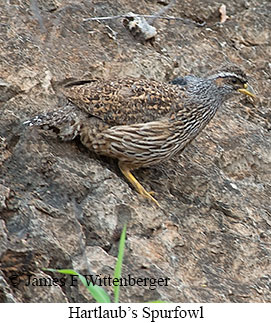
We'll begin the day with early morning birding around our lodge looking for Hartlaub's Spurfowl, which is usually only seen at first light. A second target species is the localized Herero Chat if missed earlier in the Spreetshoogte Pass or the previous afternoon. Other birds could include Verreaux's Eagle, Pearl-spotted Owlet, Violet Woodhoopoe, Rosy-faced Lovebird, Crimson-breasted Gonolek, Ashy Tit, Yellow-bellied Eremomela, Chestnut-vented Warbler, Groundscraper Thrush, Southern Cordonbleu, and Black-throated Canary.
After breakfast, we'll depart for Etosha National Park, a magnificent wildlife reserve surrounding and including the vast salt pans known as the Etosha Pan. En route we'll be looking for Kori Bustard, Black Bustard, White-quilled Bustard, Double-banded Courser, and Secretarybird.
Upon arrival and after check-in, we'll drive the roads in the park. The western part of Etosha is much drier than the eastern part, so the birds are somewhat different. Birds of particular interest include Red-crested Bustard, White-quilled Bustard, Blue Crane, Spotted Thick-knee, Temminck's Courser, Double-banded Courser, White Helmetshrike, Spike-heeled Lark, Monotonous Lark, Rufous-naped Lark, Eastern Clapper Lark, Pink-billed Lark, White-breasted Sunbird, and Long-billed Pipit. Numerous raptors are also possible including Bateleur, Brown Snake-Eagle, Martial Eagle, and Pygmy Falcon. Key target birds around the lodge are Carp's Tit, Rufous-eared Warbler, and Black-faced Babbler. Mammals tend to be dispersed in years of good rains or concentrate around permanent water in dry years. We'll visit several water holes during the game drive. With luck we may see the very localized Blue Crane at one of these. This species is very localized in Namibia with a population of less than 100 individuals.
A permanent water hole is located directly behind the lodge where evening viewing of mammals can be productive in dry years. The famous "White" Elephants covered in white dust are in eastern Etosha. Encounters with predators are always possible. African Wild Dogs are not possible, but Cheetahs, Lions, and Leopards are. Overnight at Okaukuejo NWR Resort.
DAY 9 - ETOSHA NATIONAL PARK
Early this morning we'll do some birding around the lodge. After breakfast, we'll do another game drive in western Etosha and then drive across the central region of the park to Halali. During the drive east the track skirts the Etosha Pan, normally dry except in very wet years and large enough to be visible from space. We'll be birding and game viewing en route. We should see large concentrations of wildlife around waterholes, providing excellent opportunities for photography. Birds we may see include Red-crested Bustard, African Harrier-Hawk, Lappet-faced Vulture, White-backed Vulture, Tawny Eagle, White-rumped Shrike, White-crowned Shrike, Monotonous Lark, Stark's Lark, Desert Cisticola, Marico Flycatcher, Chat Flycatcher, and Red-headed Finch.
After check-in at Halali, we'll do some birding around the lodge. The primary target bird is Bare-cheeked Babbler, typically present on the lawns or behind the lodge in dry scrub. We'll also be looking for the near-endemic Black-faced Babbler in the nearby woodlands. We might alse see Carp's Tit there. Cinnamon-breasted Buntings are often present around the entrance to the lodge. Sometimes African Scops-Owl can be found roosting near the lodge. Other possibilities are Violet Woodhoopoe, White-crested Helmetshrike, Crimson-breasted Gonolek, Black-chested Prinia, Black-chested Prinia, Southern Pied-Babbler, and Red-billed Buffalo-Weaver. In the evening we'll watch game animals come in to the waterhole behind the lodge. There we can expect to see Double-banded Sandgrouse arriving to soak up water in their feathers to carry back to their nesting or roosting site and Fiery-necked NIghtjars hawking insects narby. Overnight at Halali Resort.
DAY 10 - ETOSHA NATIONAL PARK
After some early birding and breakfast, we'll continue east toward Namutoni. This eastern section of Etosha National Park is much greener than in the west and supports some extensive woodlands. The route paralleling the Etosha Pan is quite arid but we may see a few birds and game animals en route. During our time at Namutoni, we'll do a couple game drives. More animals are present and hence so also are more predators. This section of Etosha is especially good for Leopards, and we could encounter some lions as well. Birds in this area include Swainson's Francolin, Crested Francolin, Lappet-faced Vulture, Steppe Eagle, African Hawk-Eagle, Burchell's Sandgrouse,Black-winged Pratincole, Ovambo Sparrowhawk (most likely in years of good rains), Meyer's Parrot, Hartlaub's Babbler, Black-faced Babbler, Flappet Lark, Wattled Starling, Spectacled Weaver, Village Weaver, Red-billed Quelea, and Eastern Paradise-Whydah. Also possible but usually difficult to find is Southern Brown-throated Weaver.
In the afternoon we may drive north toward the Andoni Plains on the eastern edge of the Etosha Pan. Our main purpose visiting there is to look for Blue Crane if missed earlier in the west. Also likely there are South African Shelduck, Three-banded Plover, Kittlitz's Plover, Chestnut-banded Plover, and various migratory shorebirds. Large numbers of mammals often congregate in this area including African Elephant, Plains Zebra, Common Warthog, Blue Wildebeest, Springbok, and occasionally predators. Out on the open plains we may see the scarce Burchell's Courser. There are a number of other waterholes in this area where vultures and raptors such as White-backed Vulture, Bateleur, Tawny Eagle, and Pale Chanting-Goshawk sometimes appear. Upon our return to Namutoni we may find Ashy Tit, Long-billed Crombec, and Burnt-neck Eremomela. Other possibilities include Black Cuckoo, Pied Cuckoo, Common Scimitarbill, African Golden Oriole, African Paradise-Flycatcher, Violet-backed Starling, White-breasted Sunbird, and Red-headed Weaver.
After dinner, we may go out on a night game drive when many animals are more active. We could possibly see Aardvark, South African Spring Hare, Wildcat, Spotted Hyena, Bat-eared Fox, and Cape Fox. Overnight at Namutoni Rest Camp.
DAY 11 - ETOSHA & WATERBERG
We'll do some early birding around our lodge. Then, after breakfast, we'll depart for the Waterberg Plateau area. A stop at the sewage ponds in Otjiwarongo may produce White-faced Whistling-Duck, Southern Pochard, Sacred Ibis, and African Swamphen, African Jacana. As we drive south, we may see Steppe Eagle on telephone poles along the way.
Waterberg is an isolated plateau north of Windhoek with dramatic red sandstone cliffs thas are protected at a national park. The plateau below the Waterberg Massif supports a unique mix of woodland birds, making it one of Namibia's best birding destinations. Special birds there include the endemic Damara Red-billed Hornbill, the near-endemic Hartlaub's Spurfowl, Rüppell's Parrot, White-tailed Shrike, Carp's Tit, and Rockrunner along with African Barred Owlet, Violet Woodhoopoe, Common Scimitarbill, African Gray Hornbill, Golden-tailed Woodpecker, Pririt Batis, Crimson-breasted Gonolek, Green-backed Camaroptera, Burchell's Starling, White-browed Scrub Robin, Marico Sunbird, White-bellied Sunbird, Chestnut Weaver, Violet-eared Waxbill. Overnight at Waterberg Resort.
DAY 12 - WATERBERG & WINDHOEK
We'll spend the morning birding around our lodge at Waterberg. After lunch, we'll depart for Windhoek, about a 3½ to 4½-hour drive. Overnight at Arebbush Travel Lodge.
DAY 13 - INTERNATIONAL FLIGHT HOME
Our schedule this day depends on flight schedules. As time permits, we'll do some final birding around Windhoek to look for anything missed earlier in the tour. The tour ends at the airport in Windhoek.
ACCOMMODATIONS
We'll be staying in comfortable, moderately priced hotels and very nice lodges throughout this tour.
BIRDING LOCALES
FOR THIS TOUR