


SOUTHEAST HIGHLANDS TOUR
Tour Description

PERU
BIRDING TOUR
ANY TIME*
| Duration: | 9 days, 8 nights |
| Group Size: | 2-4 |
| 2-3 Persons Price: | $3775 |
| 4 Persons Price: | $3575 |
| Single Suppl: | $350 |
| Est #Species: | 175-225 |
| Pace: | Easy |
| Difficulty: | Easy |
| Best Time:: | May-Jun, Aug-Oct |
| * This tour is available for any dates of your choosing provided guide services and accommodations are available. | |
DAY 1 - CUSCO
Arrive at Cusco airport and transfer to your nearby hotel. Overnight at a hotel in Cusco.
DAY 2 - HUAYPO LAGOON & APURIMAC CANYON
We'll depart early for Huaypo Lagoon, a prime destination for Andean lake species, located about an hour's drive northwest of Cusco. This lagoon is at high elevation and surrounded by arid montane grassland and scrub. The best time to visit is during September-December when many palearctic migrants are present.
Possibilities on the water include Andean Goose, Yellow-billed Pintail, Puna Teal, Yellow-billed Teal, White-tufted Grebe, and Andean Coot. Marshy shores are home to Plumbeous Rail, Wren-like Rushbird, Andean Negrito, Yellow-winged Blackbird and the striking Many-colored Rush Tyrant. Other birds nearby include Andean Lapwing, Andean Gull, Puna Ibis, and Black-faced Ibis.
After some productive birding there, we'll continue on toward the Apurimac Canyon, about a 2½ hour drive. As we reach the canyon, we'll make a stop in drier scrublands along the valley floor to look for the endemic Pale-tailed Canastero. We might also see Blue-tailed Emerald, White-bellied Emerald, White-eared Puffbird, Crimson-mantled Woodpecker, Mitred Parakeet, Black-backed Grosbeak, and Blue-and-yellow Tanager in this area.
We'll devote the afternoon to birding in the Chonta Canyon, translated into English "Canyon of Condors". This natural sanctuary is renowned for condor viewing and offers breathtaking views of the Apurimac River. The viewpoint is reached via a moderately strenuous 4.7km (2 mile) hike at the rather high altitude of 3400m (11,150 ft) and is the only place in the area where condors can actually be seen. We'll then continue on to our lodge near Limatambo. During early evening we'll do some owling, looking for the seldom-seen Buff-fronted Owl. We might also find Koepcke's Screech-Owl and Peruvian Pygmy-Owl. Overnight at La Isla de Limatambo Lodge.
DAY 3 - APURIMAC VALLEY
We'll spend this day birding the Apurimac Valley between Mollepata and Soraypampa. We have 3 major target species, Vilcabamba Tapaculo, Apurimac Spinetail, and Apurimac Brushfinch. Previously, these endemics could only be seen by undertaking a very strenuous hike into the Ampay Reserve located near Abancay, but now they are readily found along the Mollepata-Soraypampa Road at the base of the Salcantay Mountain near the start of the trek to Santa Teresa and Machu Picchu. We can also expect to see White-tufted Sunbeam, Green-and-white Hummingbird, Rusty-fronted Canastero, Creamy-crested Spinetail, and Chestnut-breasted Mountain-Finch and the very locally distributed Chestnut-capped Brushfinch, all Peruvian endemics, while birding this area.
More widely distributed birds present in this canyon include Purple-backed Thornbill, Mountain Velvetbreast, White-bellied Hummingbird, Bar-bellied Woodpecker, Crimson-mantled Woodpecker, Bar-bellied Woodcreeper, Red-crested Cotinga, White-banded Tyrannulet, Tawny-rumped Tyrannulet, Tit-like Dacnis, and other species. Overnight at La Isla de Limatambo Lodge.
DAY 4 - APURIMAC CANYON & OLLANTAYTAMBO
This morning we'll do some birding in the drier sections of the Apurimac Valley or more humid back side of Bosque Ampay, depending on what species we've seen on previous days. After lunch, we'll transfer to Ollantaytambo in the Sacred Valley of the Inca. On the way we'll make a slight detour to visit the Ensifera Garden and Hummingbird Feeders (Santuario de Colibries - Ensifera), located near the town of Yanahuara. Our primary target bird there is the spectacular Bearded Mountaineer, which is most likely visiting the feeders in late afternoon. The feeders there attract as many as 20 species of hummingbirds including its namesake, the stunning Sword-billed Hummingbird, as well as Amethyst-throated Sunangel, Speckled Hummingbird, Long-tailed Sylph, Green-tailed Trainbearer, Blue-mantled Thornbill, Shining Sunbeam, Giant Hummingbird, Long-billed Starthroat, White-bellied Woodstar, Green-and-white Hummingbird, and others. Overnight at a hotel in Ollantaytambo.
DAY 5 - CARRIZALES & ABRA MALAGA
We'll depart very early for the Abra Malaga pass, located at an elevation of about 4300m (14,100 ft). Once there, we'll hike down into a valley supporting due to the high altitude Polyepis woodland where the critically endangered Royal Cinclodes occurs. The hike back up a somewhat steep trail can be challenging due to the high altitude, so this excursion is an optional part of our tour for those physically fit enough to do it. An alternative is to hike up the ridge above the pass where a patch of Polylepis offers the possibility of seeing the Royal Cinclodes there, although it has become increasingly difficult to find at this site. At either site we can expect to see the endemic White-browed Tit-Spinetail, Junin Canastero, and Marcapata Spinetail and the near-endemic Ashy-breasted Tit-Tyrant. Also possible though unlikely is the secretive Puna Tapaculo. Checking the steep cliffs often reveals both Brown-bellied Swallow and Andean Swallow. And, it's always possible to detect an Andean Condor soaring overhead. Other birds at this site include Blue-mantled Thornbill, Tawny Tit-Spinetail, Cream-winged Cinclodes, White-winged Cinclodes, Ash-breasted Tit-Tyrant, Taczanowski's Ground-Tyrant,and Giant Conebill.
Along the road at the pass interesting species include Andean Goose, Andean Lapwing, Plumbeous Sierra-Finch, Ash-breasted Sierra-Finch, and sometimes Slaty Finch. Below the pass in the Carrizales area, just below tree line, is some stunted cloud forest where we could encounter birds such as Brown-backed Chat-Tyrant, Red-crested Cotinga, Moustached Flowerpiercer, and Black-throated Flowerpiercer. Overnight at a hotel in Ollantaytambo.
DAY 6 - ABRA MALAGA, IPAL ECOLODGE. & VILCABAMBA
Today we again cross the Abra Malaga pass but this time continue down the other side on our way to Vilcabamba. The avifauna is quite different on this much more humid side of the pass. There we will be looking for the endemic Unstreaked Tit-Tyrant, Inca Wren, Cuzco Brushfinch, and Parodi's Hemispingus and the near-endemic Puna Thistletail and Three-striped Hemispingus.
We then continue toward Vilcabamba, stopping at the Ipal Ecolodge for some more birding there. Major attraction at the lodge are the hummingbird feeders. The main target is the spectacular Swallow-tailed Hummingbird, a largely Brazilian species that has a small population in the Urubamba Valley. Many other more widely distributed species come to the feeders as well. We'll have the afternoon to bird around the lodge grounds where we can see Andean Cock-of-the-rock on a well-known lek along with various other species. By mid-afternoon we must continue on for the 2½-hour drive to the town of Vilcabamba. Overnight at a hotel in Vilcabamba.
DAY 7 - CORDILLERA VILCABAMBA & QUILLABAMBA
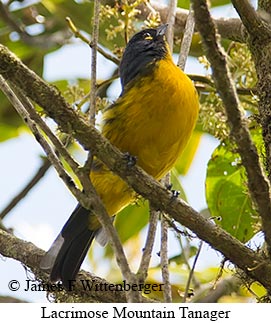
We'll spend much of the day birding the Vilcabamba area. Our primary target birds are the localized endemic Vilcabamba Thistletail and Vilcabamba Spinetail. It's also possible to see the endemic Johnson's Tody-Flycatcher. Strangely, there is a localized population of this mainly northern Peru species in this valley. Other notable birds we could see include Rufous-capped Thornbill, Red-and-white Antpitta, Puna Tapaculo, Marcapata Spinetail, Ash-breasted Tit-Tyrant, Inca Wren, Fulvous Wren, Black-capped Hemispingus, Lacrimose Mountain Tanager, and Chestnut-bellied Mountain Tanager. After lunch, we'll depart for a nearly 3-hour drive to Quillabamba. We'll make a few stops along the way where we could find the endemic Tricolored Brushfinch and other birds such as Andean Guan, Versicolored Barbet, Ocellated Piculet, and Silver-backed Tanager. Overnight at a hotel in Quillabamba.
DAY 8 - QUILLABAMBA
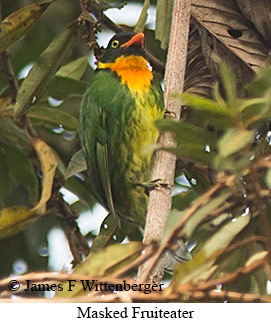
Quillabamba lies in the lowlands at an elevation of about 1050m (3450 ft), a stark contrast to the high elevation sites we visited previously on this tour. We'll spend the morning birding the dirt track through the Calquiña Valley. Target species include the endemic Creamy-bellied Antwren and Masked Fruiteater along with the near-endemic Unadorned Flycatcher. Many other lower elevation species are also present including White-throated Quail-Dove, Rufous-booted Racket-tail, Andean Motmot, Versicolored Barbet, Ocellated Piculet, Variable Antshrike, Scaled Antpitta, Mottle-cheeked Tyrannulet, Sclater's Tyrannulet, Blue-naped Chlorophonia, and Flame-faced Tanager. Overnight at a hotel in Quillabamba.
DAY 9 - TRANSFER
We may have time this day to do some birding, either around Quillabamba or along the road toward Ollantaytambo and Cusco, depending on what we've not seen previously. If you've decided to do our extension to Machu Picchu, we'll reach Ollantaytambo in time to take an afternoon train to Aguas Calientes. Otherwise, we'll continue on to Cusco, arriving in time for a late afternoon flight from there. Tour ends in Cusco.
TOUR NOTES
Can be combined with our Manu Road or Tambopata tours to create a more extensive tour experience.
ADDITIONAL INFO
(Not on Menu Above)
BIRDING LOCALES