


AMAZON LOWLANDS/IQUITOS TOUR
Tour Description

PERU
BIRDING TOUR
ANY TIME*
| Duration: | 15 days, 14 nights |
| Group Size: | 2-4 |
| 2-3 Price: | $6400 |
| 4+ Price: | $6100 |
| Single Suppl: | $700 |
| Est #Species: | 375-425 |
| Pace: | Easy |
| Difficulty: | Easy |
| Best Time: | Jun-Oct |
| * This tour is available for any dates of your choosing provided guide services and accommodations are available. | |
DAY 1 - LIMA
Arrive at international airport in Lima and transfer to your hotel near the airport. Night at LimaQ Hotel.
DAY 2 - IQUITOS & ACTS FIELD STATION AND CANOPY WALKWAY LODGE
Our tour begins with an early morning flight from Lima to Iquitos. In Iquitos we'll join our boat for a 3-hour transfer down the Amazon River about 50 miles to the Napo River and then upstream for 15 minutes to the Sucusari River, a tributary of the Napo River. We'll have an instant feeling of remoteness once we leave Iquitos behind. It's the beginning of a truly memorable Amazon adventure.
Upon our arrival at the ACTS Field Station and Canopy Walkway, we'll quickly check in, enjoy a delicious lunch, and begin birding. Our first effort will be a visit to the medicinal gardens at the lodge. There our primary target bird is the recently described Orange-eyed Flycatcher. We'll then do our first exploration of the extensive network of canopy walkways through the terra firme forest around the lodge. These walkways will give us access to canopy birds that is unsurpassed anywhere else in this part of the Amazon basin. Overnight at ACTS Canopy Walkway Lodge.
DAYS 3-5 - ACTS FIELD STATION AND CANOPY WALKWAY
We have 3 full days to explore the forest around the field station. Each day will begin with a very early start on the canopy walkways. Canopy birds are only active for a few hours in the early morning, with everything going quiet in just a few hours once the hot tropical sun heats up the canopy. At that point we'll begin our exploration of the numerous trails through the forest, patiently searching for the many shy birds to be found in the undergrowth.
Each morning, as dawn breaks above the horizon, we'll be on the canopy walkways listening to the whistles of tinamous, the hoots of motmots, and the reverberating calls of toucans. We'll be seeking mixed species flocks moving through the canopy and then enjoying close-up views of colorful tanagers such as Turquoise Tanager, White-bellied Tanager, Paradise Tanager, Opal-rumped Tanager, Opal-crowned Tanager, Bay-headed Tanager, and Green-and-gold Tanager, in flocks organized around a nuclear species, most commonly the Fulvous Shrike-Tanager, and sometimes accompanied by Black-faced Dacnis, Yellow-bellied Dacnis, Blue Dacnis, Short-billed Honeycreeper, Purple Honeycreeper, and Green Honeycreeper, perhaps along with a few woodcreepers, foliage-gleaners, and flycatchers. Other flock followers could include White-fronted Nunbird, Moustached Antwren, and Dugand's Antwren. We'll be seeing a variety of macaws and parrots such as Orange-cheeked Parrot, Mealy Amazon, Orange-winged Amazon, Black-headed Parrot, Maroon-tailed Parakeet, and Red-and-green Macaw as they depart for fruiting trees. Then there are the more solitary species that perch inconspicuously in the upper canopy such as Black-bellied Cuckoo, Paradise Jacamar, Golden-collared Toucanet, Yellow-browed Tody-Flycatcher, and Lawrence's Thrush. We'll be scanning the treetops looking for more obvious birds making their presence known and simply perching up high such as White-necked Puffbird, Spangled Cotinga, and of course White-throated Toucan, and Channel-billed Toucan. Raptors we could well see from the walkways include Double-toothed Kite, Red-throated Caracara, and the much scarcer Black-faced Hawk.
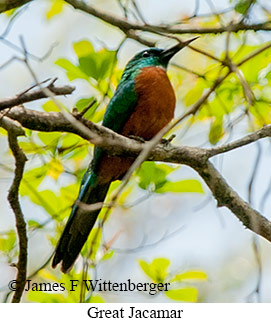
By mid-morning we'll be done with the canopy walkways and on trails leading through the rainforest. We'll be on the lookout for mid-story, understory, and undergrowth birds, many thinly distributed through the forest, some very shy and difficult to see, virtually all of interest to us. Mid-levels in the forest are home to inconspicuous birds like Collared Puffbird, Lanceolated Monklet, and Rusty-breasted Nunlet, not secretive but often overlooked because they sit quietly without moving around much. A good variety of antbirds live in this forest including 15 species of antshrikes, 10 species of antwrens, and 13 species of antbirds along with Black Bushbird, Rufous-backed Stipplethroat,, and Ornate Stipplethroat. We'll on the lookout for the 15 species of woodcreepers along with Red-billed Scythebill and Curve-billed Scythbill. We should see a variety of the dozen species of woodpeckers, Purplish Jacamar, Great Jacamar, Scarlet-crowned Barbet, Gilded Barbet, Lemon-throated Barbet, and several species of aracaris. There is a wide variety of flycatchers plus Wing-barred Piprites, Ringed Antpipit, and Brownish Twistwing. The list goes on. After dark we'll especially look for the Nocturnal Curassow, as this is one of the few places where seeing this species is a real possibility. Overnights at ACTS Canopy Walkway Lodge.
DAYS 6-7 - EXPLORNAPO LODGE
After breakfast and a 15-minute boat trip back toward the Napo River, we'll begin our birding at Explornapo Lodge, where the main habitat is varzea forest. This change of habitat results in a change of species composition, so we'll be looking for many new ones for the next two days. During our stay we'll also take a boat out to some river islands in the lower stretch of the Napo River. Much of the birding during our stay will be by boat along narrow blackwater waterways through the forest. There is also a 500m canopy walkway that gives us eye-level views of canopy birds.
We should arrive at the lodge early enough to merit birding the canopy walkway, where we'll be looking expecially for mixed species flocks. The nucleus species in these flocks is once again typically the Fulvous Shrike-Tanager. Other birds in these flocks include Spot-winged Antshrike, Buff-throated Woodcreeper, Chestnut-winged Hookbill, Rufous-bellied Euphonia, Flame-crested Tanager, and Yellow-backed Tanager. Sometimes Cream-colored Woodpecker, Chestnut Woodpecker, and Yellow-throated Woodpecker join these flocks for a short time as well. Other birds that appear in canopy flocks include Gilded Barbet, Lemon-throated Barbet, Chestnut-shouldered Antwren, Wing-barred Piprites, and Yellow-margined Flatbill.
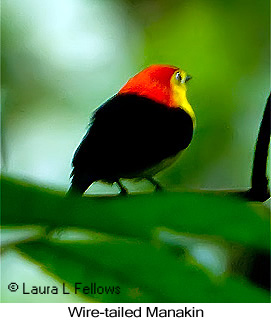
As bird activity diminishes in the canopy, we'll begin birding the blackwater tributories in a small boat. There we'll be looking for the restricted-range White-chinned Jacamar along with manakins such as Blue-capped Manakin, Wire-tailed Manakin, Kinglet Manakin, and Striolated Manakin, and various other birds of the understory such as Red-necked Woodpecker, Banded Antbird, Gray Antbird, Slate-colored Antbird, and Fawn-throated Foliage-gleaner. Early on our second day at the lodge we'll make a foray out onto the Napo River to visit some of the many river islands on this section of the river. These islands are prime habitat for specialties such as Castelnau's Antshrike, Black-and-white Antbird, Lesser Hornero, Parker's Spinetail, and White-bellied Spinetail. Later in the morning we'll visit an oxbow lake to look for Little Woodpecker, Lineated Woodpecker, Silvered Antbird, Plumbeous Antbird, White-shouldered Antbird, Dot-backed Antbird, Johannes's Tody-Tyrant, Dusky-capped Flycatcher, Buff-breasted Wren, and Varzea Thrush.
We'll spend our afternoons birding the clearing around the lodge where we may see Speckled Chachalaca, Ruddy Pigeon, Pheasant Cuckoo, Pale-tailed Barbthroat, Sooty Barbthroat, Crane Hawk, Amazonian Barred-Woodcreeper, Collared Gnatwren, Coraya Wren, and White-necked Thrush. We'll also spend some of our time in the afternoon back out on a boat birding backwaters looking for Sungrebe, Rufescent Tiger-Heron, Agami Heron, and Green-and-rufous Kingfisher, and other birds.
DAY 8 - EXPLORNAPO LODGE & IQUITOS
We'll spend the morning birding around the lodge, either on the canopy walkway, along some trails near the lodge, or out on the boat, depending on what birds we've missed the previous day. After lunch we'll transfer by boat back to Iquitos. Overnight at a hotel in Iquitos.
DAYS 9-10 - ALLPAHUAYO-MISHANA RESERVE
We'll spend the next two days birding the nearby Allpahuayo-Mishana Reserve. Birding is along an accessible network of trails near the research center, some community trails reached by boat, and along the main highway. Trails in this area can be very muddy.
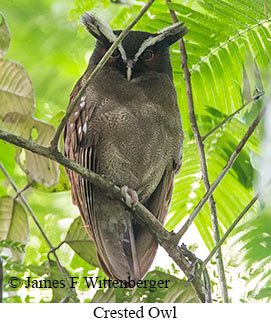
The white-sand forest in the reserve is home to the newly described Ancient Antwren, the endemic Allpahauyo Antbird and Mishana Tyrannulet, the northern subspecies of Zimmer's Antbird, and the extremely rare Iquitos Gnatcatcher. Other special birds include Brown-banded Puffbird, Pearly Antshrike, Yellow-browed Antbird, Orange-crowned Manakin, White-crowned Manakin, Pompadour Cotinga, Cinnamon-crested Spadebill, Fuscous Flycatcher, Citron-bellied Attila, and Yellow-throated Flycatcher. Other more widely distributed species we could see in the reserve include Gould's Jewelfront, White-chested Puffbird, Yellow-billed Nunbird, Waved Woodpecker, White-winged Parakeet, Dusky-billed Parrotlet, Plain-throated Antwren, Rufous-tailed Flatbill, and Grayish Mourner. After dark we'll try for Rufous Potoo, White-winged Potoo, Crested Owl, and Spectacled Owl. One afternoon we may visit the nearby Nanay River to look for Black-crested Antshrike and the recently split Band-tailed Nighthawk. Nights at an air-conditioned hotel in Iquitos. The birding can be very slow and takes some persistence to these these species.
DAY 11 - IQUITOS & MUYUNA AMAZON LODGE
After breakfast in Iquitos, we'll transfer to our next destination, the Muyuna Amazon Lodge, a family-owned boutique ecolodge located about 87 miles upstream from Iquitos within the Tamshiyacu-Tahuayo Reserve. Reaching the lodge requires a 2-hour land transfer by road followed by a 1-hour boat trip up the Yanayacu River. The lodge is renowned for it's wildlife viewing as well as birding. The habitat is Amazonian terra firme and varzea rainforest, blackwater tributaries of the Yanayacu River, oxbow lakes, and river islands. We can expect to see 150-200 species of birds and a nice variety of mammals during our stay. We'll have a local guide to help us in that effort along with the expert birding guide leading our tour. After our arrival, we'll enjoy lunch and then begin our birding in this rich environment. Overnight at Muyuna Amazon Lodge.
DAYS 12-14 - MYUNA AMAZON LODGE
We have 3 full days to bird this amazing place. We'll be birding trails through terra firme forest, a small boat through tributaries into varzea forest, and visit river islands and oxbow lakes during our stay. Our stay here is our first visit to the southern side of the Amazon, which acts as a natural barrier for some bird species, which do not occur on the other side of the Amazon. These include Rufous-necked Puffbird, Blue-cheeked Jacamar, and Saturnine Antshrike. We expect to see the near endemic and localized Black-tailed Antbird, quite common here. Another target bird we'll be seeking is the rare and endangered Wattled Curassow with the help of our local guide. Muyuna is the most accessible place in the entire Amazon basin to see this species.
Birds we may well see while birding trails through terra firme forest include Cinereous Tinamou, Undulated Tinamou, Black-tailed Trogon, Bluish-fronted Jacamar, Chestnut-eared Aracari, Curl-crested Aracari, Great Antshrike, Barred Antshrike, Olivaceous Woodcreeper, Plain-crowned Spinetail, Blue-capped Manakin, Wire-tailed Manakin, Black-tailed Tityra, Rusty-fronted Tody-Flycatcher, Cinnamon Attila, and Gray-headed Tanager.
While birding varzea forest we may see birds such as Horned Screamer, Muscovy Duck, Little Cuckoo, Gray-cowled Wood-Rail, Black-banded Crake, Sungrebe, Wattled Jacana, Hoatzin, Sunbittern, Green Ibis, Black-collared Hawk, Hook-billed Kite, five species of kingfishers Swallow-winged Puffbird, Laughing Falcon, Black-throated Antbird, Striped Woodcreeper, Varzea Schiffornis, Black-capped Donacobius, and many more.
During our stay we'll visit a river island on the Yanayaco River where we may see Plain-breasted Piculet, Zimmer's Woodcreeper, Brownish Elaenia, and other island specialists we may have missed earlier.
There is also a nice variety of mammals around the lodge. Out on the river are Pink Dolphins and Gray Dolphins. Common primates include Nancy Ma's Night Monkey, Coppery Titi Monkey, and Bolivian Red Howler. We'll also take a short walk after dark to look for Pygmy Marmoset, the smallest primate in the Neotropics, and we may also see some nocturnal birds such as Great Potoo and Spectacled Owl. Nights at Muyuna Amazon Lodge.
DAY 15 - MUYUNA AMAZON LODGE & IQUITOS
We'll spend the morning birding around the lodge. After lunch we'll retrace our steps back to Iquitos, arriving there around 4:00pm in time for an evening flight back to Lima. The tour ends at the airport in Lima.
TOUR NOTES
Internal flights are not included in the tour price.
ACCOMMODATIONS
The ACTS Canopy Walkway Lodge and Explornapo Lodges are comfortable but rustic. Both lodges only have pit toilets and shared showers, all clean but not in the rooms. Both lodges have very good meals. The Muyuna Amazon lodge is nicer with private bathrooms though still somewhat rustic. Hotels in Iquitos are comfortable and similar to moderately priced hotels in other Peruvian cities. In Iquitos the accommodations are moderately priced, comfortable hotels.
BIRDING LOCALES
FOR THIS TOUR