


EASTERN BOLIVIA TOUR
Tour Description

BOLIVIA
BIRDING TOUR
ANY TIME*
| Duration: | 13 days, 12 nights |
| Group Size: | 2-4 |
| 2-3 Persons Price: | $5640 |
| 4+ Persons Price: | $5340 |
| Single Suppl: | $300 |
| Est #Species: | 350-400 |
| Pace: | Moderate |
| Difficulty: | Moderate |
| Best Time: | June-Nov |
| * This tour is available for any dates of your choosing provided guide services and accommodations are available. | |
DAY 1 - ARRIVE LA PAZ
Arrive La Paz. Overnight in a hotel in La Paz.
DAY 2 - FLIGHT & RIBERALDA
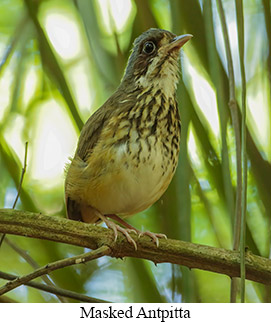
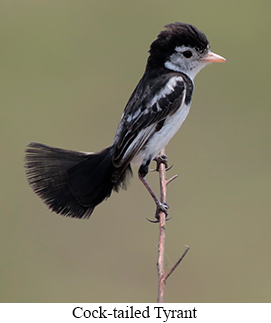
We'll take a very early domestic flight from La Paz to Riberalta, which is located in far northern Bolivia not far from the border with Brazil. The flight arrives in mid morning. Upon arrival we'll immediately go birding. Our primary target species is Masked Antpitta, which is best found near the small town of Marigüal, located an hour or so west of Riberalta. This species occupies riverine habitat of Varzea forest in a very restricted area of northern Bolivia. If the guide has a bird staked out. we should be able to find the bird in a couple hours. Otherwise, it will take some effort. After a hopefully successful excursion to see the antpitta followed by lunch, we'll drive east a half hour to the San Lorenzo pampas area.This dry cerrado region is a unique mix of tropical savanna, forest patches, and seasonally flooded plains. It's home to several range-restricted birds. We'll have the afternoon and early evening to look for Sharp-tailed Tyrant, Rufous-sided Pygmy-Tyrant, Cock-tailed Tyrant, Dark-throated Seedeater, and Black-masked Finch. We should also see Greater Rhea, which regularly occurs there. Overnight at a hotel in Riberalta.
DAY 3 - RIBERALTA
If all went well the preceding day, we'll go north to bird tropical Amazonian rainforest at the Aquicuana Natural Reserve. This infrequently visited reserve offers a second and perhaps better chance of seeing Masked Antpitta if we just couldn't get it the day before. It also offers a chance of seeing the rare-to-uncommon near-endemic Red-necked Aracari, the uncommon near-endemic Large-billed Antwren, the fairly common near-endemic Dusky-green Oropendola, and the scarce and local near-endemic Black-and-tawny Seedeater. Many other more widely distributed species are likely to be seen as well. Overnight in a hotel in Riberalta.
DAY 5 - RIBERALTA & TRANSFER
This day will be devoted to the long drive to Rurrenabaque and then on to Sadiri Lodge. This journey on the once dirt road used to take as much as 18-20 hours during dry season and was impassible during rainy season. Now, thanks to a decade long construction project that was finally completed in 2025, the transfer can now be done in about 7½ hours to the town of Rurrenabaque plus an additional 2½ hours to the lodge. We have the option of going all the way to the lodge or spending a night at a hotel in Rurrenabaque. NIght in a hotel in Rurrenabaque or at Sadiri Lodge.
DAYS 6-8 - SADIRI LODGE
Sadiri Lodge protects some 34,000ha of land within Madidi National Park. The habitat in most of the reserve is tropical rainforest. Some 540 species of birds have been recorded there, and we'll spend 3 full days seeing as many of them as we can. Birding is along a jeep track through the forest as well as on a network of trails within the forest. Many of the trails have steep sections that go up and down the hilly terrain so most of our birding time will be spent along the jeep track. A major appeal of the site is the ability to bird from ridges looking down into the forest canopy along the road, making canopy birds much easier to see. Mixed species flocks abound in the forest and are easy to see because of this topography. There are also hummingbird feeders near the lodge. Over 500 species have been seen around the lodge and the surrounding national park.
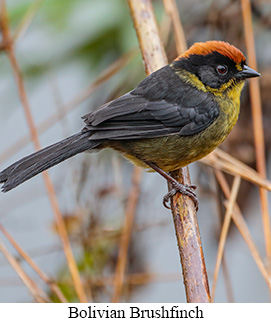
Our long list of target birds include the fairly common endemic Bolivian Brushfinch and near-endemics with varying degrees of commonness that includes White-browed Hermit, Blue-moustached Barbet, Rio Madeira Stipplethroat, Ashy Antwren, Brownish-headed Antbird, Slaty Gnatcatcher, Bolivian Recurvebill, Yungas Manakin, Cinnamon-faced Tyrannulet, Yungas Tyrannulet, Dusky-green Oropendola, and Cuzco Warbler. A number of nocturnal birds can be spotted during early evenings near the lodge. These include Great Potoo, Tawny-bellied Screech-Owl, Crested Owl, Band-bellied Owl, Subtropical Pygmy-Owl, and Black-banded Owl.
Among the many other possibilities are Pavonine Cuckoo, White-throated Woodpecker, Rose-fronted Parakeet, Hairy-crested Antbird, Sharp-tailed Streamcreeper, Round-tailed Manakin, Sharpbill, Yungas Tyrannulet, Slaty-capped Shrike-Vireo, Olive Oropendola, and Yellow-shouldered Grosbeak. Hummingbird feeders at the lodge attract a nice variety of species including Gould's Jewelfront, Blue-tailed Emerald, Gray-breasted Sabrewing, and Fork-tailed Woodnymph. Aside from all these species, there is a long list of locally distributed and more widely distributed birds in the reserve that will keep us occupied throughout our visit. Nights at Sadiri Lodge.
DAY 6 - SADIRI LODGE & TRINIDAD
This morning we'll depart early for a 7-hour transfer to the town of Trinidad. We expect to arrive in time for some afternoon birding in gallery forest outside town to look for the near mythical Unicolored Thrush. Other possibilities include Buff-bellied Hermit, Band-tailed Antbird, Beni Grackle, and Gray-headed Tanager. Overnight at a hotel in Trinidad.
DAY 9 - TRINIDAD
Today we'll drive south about 60km to a private reserve near the Beni town of Loreto to look for the critically endangered Blue-throated Macaw at a private reserve near town. The best time to visit is nesting season from November to April during rainy season, but the birds are resident year-round. After returning to Trinidad and having lunch, we'll take a late afternoon flight to Santa Cruz de la Sierra for an overnight stay. Overnight at a hotel in Santa Cruz.
DAY 10 - CAMIRI
The semiarid Chaco region of southeastern Bolivia is rarely included in birding tour itineraries. Some of the Chaco birds can be seen in the Lomas de Arena area, but many are only found farther south. On this day we'll drive south to our base for the next 3 nights, about a 4 hour drive to the town of Camiri. Thanks to a recently paved road, this drive is no longer the challenge it once was. During the transfer we'll pass through a transitional zone of tall, dry forests where we'll spend some time looking for the near-endemic Bolivian Slaty-Antshrike and Stripe-backed Antbird. We'll also pass through some more humid foothill woodlands where we'll stop to look for Turquoise-fronted Amazon, Green-cheeked Parakeet, and Plush-crested Jay. Overnight at a hotel in Camiri.
DAY 11 - SOUTH OF CAMIRI
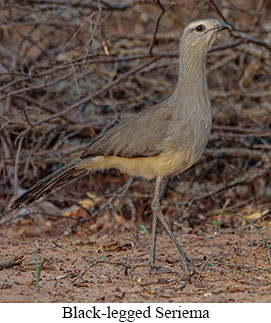
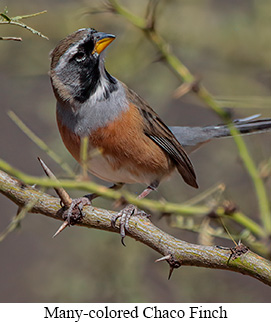
During this day we'll drive south much the way to the Argentina border. We'll spend all day looking for specialties found in thorn forests, scrub, and savanna of this region. It's essential that we get an early start, as bird activity drops off precipitously once it gets hot during the middle of the day. Probably the best birding in Chaco habitat is the Boyuibe Chaco, located about 2 hours south of Camiri. Here we will be seeking a variety of Chaco specialties including Chaco Chachalaca, Chaco Earthcreeper, the rather scarce Crested Hornero, Little Thornbird, Lark-like Brushrunner, Short-billed Canastero, Fawn-breasted Wren, and Many-colored Chaco Finch. We'll make a special effort to see the secretive Crested Gallito in thorn scrub of the area. A major target species is Black-legged Seriema, more easily seen here than elsewhere. With luck we could even find the very scarce Black-bodied Woodpecker and Spot-backed Falconet and maybe even the rather rare Scimitar-billed Woodcreeper. Other possibilities include White-barred Piculet, Checkered Woodpecker, Cream-backed Woodpecker, and Cinereous Tyrant. At dusk we'll be on the lookout for Little Nightjar. Overnight at a hotel in Camiri.
DAY 12 - CAMIRI
We'll spend our second full day in the Chaco birding some foothill woodlands north of town. Along the road we're sure to see Red-crested Cardinal, Black-capped Warbling Finch, Red-crested Finch, and Golden-billed Saltator. We'll work denser vegetation to ferret out a couple skulkers, Ochre-faced Tody-Flycatcher and Moss-backed Sparrow. We also hope to see Yungas Guan and Ocellated Piculet. We'll eventually reach the town of Launillas, where nearby wetlands offer chances for birds such as Southern Screamer, Comb Duck, Ringed Teal, Brazilian Teal, and Spot-flanked Gallinule. Overnight at a hotel in Camiri.
DAY 13 - CAMIRI & SANTA CRUZ
The plan this day will depend on flight schedule of participants later in the day. We'll likely spend the morning birding around Camiri followed by afternoon transfer back to Santa Cruz. The tour ends at the airport in Santa Cruz.
TOUR NOTES
Internal flights not included in tour price. May be combined with our Central Bolivia tour.
ACCOMMODATIONS
We'll be staying in comfortable, moderately priced hotels throughout the tour except while at Sadiri Lodge. Accommodations at Sadiri are typical for an ecolodge, with comfortable cabanas in the forest and a dining area where meals are served.
BIRDING LOCALES
FOR THIS TOUR