(Phone/WhatsApp): 206-650-3425
info@exoticbirding.com

BOLIVIA APOLO
EXTENSION

Duration:6 days, 5 nights
Group Size:2-4
2-3 Price:$2500
4+ Price:$2400
Single Suppl:$800
Est #Species:175-200
Pace:Difficult
Difficulty:Difficult
Best Time:Oct-Nov
* This tour is available for any dates of your choosing provided guide services and accommodations are available.

Tour involves long drives between La Paz and Apolo. Birding is intense with substantial walking involved. Can be combined with any of our other Bolivia tours.
button Related Tours
     and/or Extensions

Related Tours

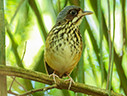
Masked Antpitta - courtesy Cesar Bollaty
Eastern Bolivia Birding Tour
13 days, 12 nights
2-3 Price: $5640
    (Single Suppl $300)
4+ Price: $5340
    (Single Suppl $300)
Click for Tour Details
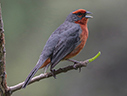
Cochabamba Mountain-Finch - courtesy Cesar Bollaty
Central Bolivia Birding Tour
15 days, 14 nights
2-3 Price: $6580
    (Single Suppl $300)
4+ Price: $6280
    (Single Suppl $300)
Click for Tour Details
button Tour Overview

Our tour extension to the Apolo region north of La Paz is focused on looking for the recently described, enigmatic Inti Tanager and the recently rediscovered Palkachupa Cotinga, the latter thought to be extent for the past 98 years. We'll drive as far as Charazani the first day, birding nearby forest in the afternoon. From there we continue north to Apolo. Once there we'll have two full days of birding, one day to the south near Aten for the endangered Palkachupa Cotinga and a second day in the Machariapo Valley for the Inti Tanager. On the final day we typically depart very early for the drive south toward La Paz, as we want time to stop for some morning birding in the Apolo Yungas en route. We'll go as far as Charazani, where we'll spend the last night. The following morning we'll transfer to La Paz, which takes about 4 hours. We may do some birding en route as time permits. The tour ends in La Paz.

button Tour Itinerary

Day 1 - Meals: BLD; Accommodation: Hotel in Charazani; Activity: Afternoon transfer to Charazani.
Day 2 - Meals: BLD; Accommodation: Hotel in Apolo or Aten; Activity: Most of day will be spent on a long drive to Apolo or Aten.
Day 3 - Meals: BLD; Accommodation: Hotel in Apolo or Aten; Activity: All day Apolo-Bolivian cerrado toward Aten.
Day 4 - Meals: BLD; Accommodation: Hotel in Apolo or Aten; Activity: All day Apolo-Machariapo dry forest.
Day 5 - Meals: BLD; Accommodation: Hotel in Charazani; Activity: Early morning Apolo Yungas. Rest of day transfer to Charazani with birding en route, arriving evening.
Day 6 - Meals: B; Accommodation: None; Activity: Morning transfer to La Paz. Tour ends at the airport. Flight home.

button Accommodations

We'll stay at the best available place in Apolo, which is likely a fairly basic guest house possibly with shared bathroom and shower facilities.

button Included Locales
button Tour Map
button Tour Considerations
:

PACE - This tour is rated as difficult and is intended for serious birders.

DIFFICULTY - Our extension to the Apolo region north of La Paz is considered difficult because it entails long drives of up to 12 hours and substantial hiking. Road conditions from La Paz to Apolo are susceptible to washouts and landslides during rainy season.

CLIMATE - The climate around Apolo is generally mild and subtropical. There is a pronounced dry season from May to October. The heaviest rainfall is from December through March.

BIRD ACTIVITY - The main breeding season of the Inti Tanager is from October through March. At other times of year, it's distribution is uncertain though it has been seen in the Apolo region during August and September. The breeding season of the Palkachupa Cotinga, considered by some to be a subspecies of Swallow-tailed Cotinga and by others as a separate species, is from early November to mid-March. The birds are very active during this time and most easily seen then.

PHOTOGRAPHY - Getting photographs of the main target birds can be challenging but is possible.

button Full Description

DAY 1 - TRANSFER TO CHARAZANI

We'll spend the morning birding around Lake Titicaca and then driving north to Charazani, about a 4-hour transfer. If the extension is added to our central Bolivia tour, this transfer will occur on the last afternoon of that tour rather than heading to the airport. At Lake Titicaca the primary target bird is the Titicaca Grebe, which can typically be seen swimming around reedbeds along the shoreline. Other likely birds include Andean Goose, Crested Duck, Plumbeous Rail, Puna Miner, Many-colored Rush Tyrant, Short-billed Pipit, Yellow-winged Blackbird, Band-tailed Sierra Finch, and Grassland Yellow-Finch. Overnight at a hotel in Charazani.

DAY 2 - TRANSFER TO ATEN

We'll spend much of the day driving to Apolo and then on to Aten south of there. Aten is located on a high Andean plateau and is mostly scrub and cattle pasture. It's the hub for birding remnant dry woodlands and scrub south of Apolo, Machariapo forest to the north and Apolo Yungas to the southwest. Overnight hotel in Aten.

DAY 3 - ATEN

The habitat near Aten is Bolivian Cerrado, an area of grassland and scrub on a plateau in the Apolo region. There is also some good Yungas cloud forest south of town. The main target species in this area is the endemic Palkachupa Cotinga. A second and more difficult target is the rare Green-capped Tanager. Seeing the tanager is hit or miss. It's typically seen in flocks in open savanna with scattered trees. The forest in the western valley south of Aten is usually better than the eastern valley. At nearby Cerro Asunta Pata there is a reasonable chance of seeing the recently described near-endemic Yungas Tyrannulet and the localized White-browed Hermit. Other good birds there include Upland Antshrike, Bolivian Tapaculo, White-crowned Tapaculo, Bolivian Recurvebill, Yungas Manakin, Yungas Tody-Tyrant, and Green-throated Tanager.

The savanna can be good for raptors such as King Vulture, Black-and-white Hawk-Eagle, Chaco Eagle, and White-tailed Hawk. Other possibilities include Black-capped Tinamou, Red-winged Tinamou, Rufous-crested Coquette, Rufous-sided Crake, and White-eared Puffbird. Interesting species in the cloud forest include Hooded Tinamou, Black-capped Tinamou, Pavonine Cuckoo, Black-and-chestnut Eagle, Red-stained Woodpecker, Ashy Antwren, Rufous-margined Antwren, and Chestnut-crested Cotinga. Overnight hotel in Aten.

DAY 4 - MACHARIAPO FOREST

We'll spend all this day birding the dry forest of Machariapo Valley north of Apolo. The valley is home to the recently described and enigmatic Inti Tanager, This species is reportedly a seasonal migrant. It's prevalent in the valley beginning in October and breeds there from November-March, spending the remainder of the year dispersed northward and into southern Peru. A rare and secretive bird also found there is the Rufous-vented Ground-Cuckoo. The Machariapo Valley is the only dependable site in Bolivia and the best site in the world to see that species. Unfortunately the best time to see it is the same dry period when the tanager is likely absent. A variety of more widely distributed species are also present, including some from the Chaco region around Santa Cruz as well as middle montane species such as Plain Antvireo, Yungas Manakin, Two-banded Warbler, and White-winged Tanager. Overnight hotel in Aten.

DAY 5 - APOLO YUNGAS & TRANSFER

The road from Apolo back to La Paz goes through lush middle elevation montane forest of Cotapata National Park. Early morning birding there is worthwhile to seek cloud forest species that may have been missed the preceding two days. Some possibilities include Andean Condor, Red-necked Woodpecker, Streak-throated Bush Tyrant, Black-billed Shrike-Tyrant, and various other Yungas birds. We then continue on to Charazani for an overnight stay there. Night at a hotel in at Charazani.

DAY 6 - END OF TOUR

We have a half-day transfer to La Paz, so we may do some birding en route back to La Paz, depending on flight schedules. We'll arrive at the La Paz airport in time for international flights home. End of tour at the airport.

DAY 7 - ARRIVE HOME

International flight home.

button Special Birds

DISTRIBUTION CODES

CodeDescriptionCodeDescription
EEndemicLCLocal
NENear EndemicRRRestricted Range

color codes

1Gray TinamouTinamus tao 
2Rufous-vented Ground-CuckooNeomorphus geoffroyiLC
3<White-vented Violetear>Colibri serrirostrisRR
4Scaled MetaltailMetallura aeneocaudaNE
5Black-and-white Hawk-EagleSpizaetus melanoleucusLC
6Black-and-chestnut EagleSpizaetus isidori 
7Gray-bellied HawkAccipiter poliogaster 
8Solitary EagleButeogallus solitarius 
9Burrowing OwlAthene cuniculariaRR
10Blue-banded ToucanetAulacorhynchus coeruleicinctisNE
11Ocellated PiculetPicumnus dorbignyanusRR
12Military MacawAra militaris 
13Chestnut-backed AntshrikeThamnophilus palliatusRR
14Upland AntshrikeThamnophilus aroyaeNE
15Ashy AntwrenMyrmotherula griseaNE
16Black-bellied AntwrenFormicivora melanogasterRR
17Bolivian TapaculoScytalopus bolivianusNE
18Eastern WoodhaunterAutomolus subulatusLC
19Beni SofttailThripophaga dimorphaE
20Yungas ManakinChiroxiphia bolivianaNE
21Swallow-tailed CotingaPhibalura flavirostrisE
22Scimitar-winged PihaLipaugus uropygialisNE
23Buff-throated Tody-TyrantHemitriccus rufigularisRR
24Unadorned FlycatcherMyiophobus inornatusNE
25Moss-backed SparrowArremon doribniiNE
26Mountain CaciqueCacicus chrysonotusNE
27Inti TanagerHeliothraupis oneilliNE
28Green-capped TanagerStilpnia meyerdeschauenseeiNE
29Burnished-buff TanagerStilpnia cayanaLC
30Red-legged HoneycreeperCyanerpes cyaneusLC
31\Dark-throated Seedeater\Sporophila ruficollis